Asylum

Accès à l’asile

    Produits

    Publications and Data

    Displaying results 21 - 30 of 35
    Opinion / Position Paper
    11
    mars
    2019
    In November 2016, FRA formulated 21 individual opinions to address the fundamental rights shortcomings identified in the implementation of the hotspot approach in Greece and Italy. Despite genuine efforts to improve the situation since November 2016, many of the suggestions contained in the 21 opinions FRA formulated at the time remain valid.
    Report / Paper / Summary
    24
    mars
    2017
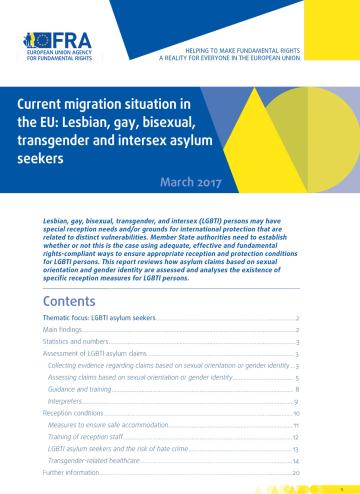
    This report reviews how asylum claims based on sexual
    orientation and gender identity are assessed and analyses the existence of
    specific reception measures for LGBTI persons.
    Opinion / Position Paper
    8
    décembre
    2016
    This opinion analyses the effects on children of the proposed recast Dublin Regulation. It covers child-specific rules as well as provisions relating to all asylum applicants that significantly affect children.
    Report / Paper / Summary
    5
    décembre
    2016
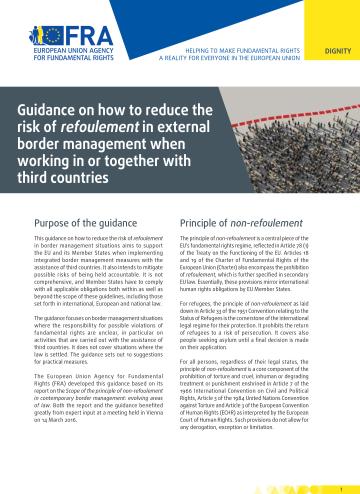
    EU Member States are increasingly involved in border management activities on the high seas, within – or in cooperation with – third countries, and at the EU’s borders. Such activities entail risks of violating the principle of non-refoulement, the cornerstone of the international legal regime for the protection of refugees, which prohibits returning individuals to a risk of persecution. This report aims to encourage fundamental-rights compliant approaches to border management, including by highlighting potential grey areas.
    Handbook / Guide / Manual
    5
    décembre
    2016
    Les États membres de l’UE participent de plus en plus à des activités de gestion des frontières en haute mer, sur le territoire de pays tiers, ou en coopération avec ces derniers, ainsi qu’aux frontières de l’UE. Ces activités peuvent comporter des risques de violation du principe de non-refoulement, la pierre angulaire du régime international juridique assurant la protection des réfugiés, qui interdit le retour d’individus vers une situation de risque de persécution. Ces orientations présentent des suggestions spécifiques sur les moyens de réduire les risques de refoulement dans ces situations. Elles constituent un outil pratique élaboré à l’aide de contributions d’experts réunis à Vienne en mars 2016.
    Opinion / Position Paper
    29
    novembre
    2016
    Without being exhaustive, this opinion discusses selected topics which touch certain Charter rights, identifying the challenges and describing measures that could be taken to mitigate the risk of actions, which are not compliant with the Charter. It does not focus exclusively on risks arising in direct relation to the involvement of EU actors on the ground, but also takes into account that the hotspot approach entails a certain share of responsibility of the EU for the situation in the hotspots overall.
    Fundamental Rights Report
    30
    mai
    2016
    Ce « Focus » examine de façon approfondie les questions de l’asile et de la
    migration dans l’Union européenne (UE) en 2015. Il se penche sur l’efficacité des mesures prises ou proposées par l’UE et
    ses États membres pour gérer cette situation, en se concentrant en particulier sur le respect des droits fondamentaux.
    Opinion / Position Paper
    6
    avril
    2016
    FRA’s opinions highlight general fundamental rights implications to be considered when applying the safe countries of origin concept. They should be read together with the relevant safeguards the Asylum Procedures Directive establishes. These safeguards provide for minimum guarantees that must also fully apply to applicants originating from countries on the proposed EU common list of safe countries of origin.
    Handbook / Guide / Manual
    22
    octobre
    2015
    Processing biometric data for immigration, asylum and border management purposes has become common. This focus paper looks at measures authorities can take to enforce the obligation of newly arrived asylum seekers and migrants in an irregular situation to provide fingerprints for inclusion in Eurodac.
    Report / Paper / Summary
    9
    octobre
    2015
    For asylum and return (i.e. expulsion) procedures to be implemented effectively, people need to be at the disposal of the authorities so that any measure requiring their presence can be taken without delay. To achieve this, EU Member States may decide to hold people in closed facilities. Less intrusive measures, which are usually referred to as alternatives to detention, reduce the risk that deprivation of liberty is resorted to excessively.