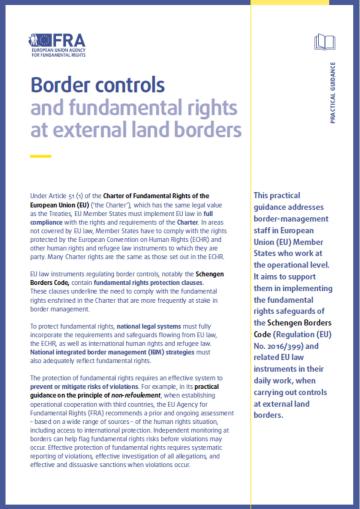
Šie norādījumi ir paredzēti robežu pārvaldības darbiniekiem ES dalībvalstīs, kuri strādā operatīvajā līmenī. Norādījumu mērķis ir palīdzēt viņiem ikdienas darbā īstenot Šengenas Robežu kodeksā (Regula (ES) 2016/399) un saistītajos ES tiesību aktos paredzētos pamattiesību aizsardzības pasākumus.
Din il-gwida hija għall-persunal tal-ġestjoni tal-fruntieri fl-Istati Membri tal-UE li jaħdem fuq livell operazzjonali. Din għandha l-għan li tgħinhom jimplimentaw, fil-ħidma tagħhom ta’ kuljum, is-salvagwardji tad-drittijiet fundamentali tal-Kodiċi tal-Fruntieri ta’ Schengen (ir-Regolament (UE) Nru. 2016/399) u l-liġi tal-UE relatata.
Deze richtsnoeren zijn bestemd voor grensbeheerpersoneel in de lidstaten van de Europese Unie (EU) dat op operationeel niveau werkt. Ze zijn bedoeld om deze medewerkers
te helpen bij hun dagelijkse werkzaamheden om de waarborgen op het gebied van de grondrechten van de Schengengrenscode (Verordening (EU) 2016/399) en de daarmee verband houdende EU-wetgeving uit te voeren.
The EU Return Directive introduced an important fundamental rights safeguard for third-country nationals ordered to leave the EU because they do not or no longer fulfil the conditions for entry and/or stay. According to the Directive, Member States must provide for an effective forced-return monitoring system.
The EU Return Directive (2008/115/EC) in Article 8 (6) introduced an important fundamental rights safeguard for third-country nationals ordered to leave the EU because they do not or no longer fulfil the conditions for entry and/or stay. According to the directive, Member States must provide for an effective forced-return monitoring system.
The Coronavirus pandemic continues to interrupt everyday life in the EU in unprecedented ways. But the way it affects our societies is shifting. As governments gradually lift some of the measures put in place to contain the spread of COVID-19, new fundamental rights concerns arise: how to ensure that the rights to life and health are upheld as daily life transitions to a ‘new normal’. This Bulletin looks at declarations of states of emergency, or equivalent, and how they came under scrutiny. It considers
the impact on fundamental rights in important areas of daily life, and includes a thematic focus on the pandemic's impact on older people.
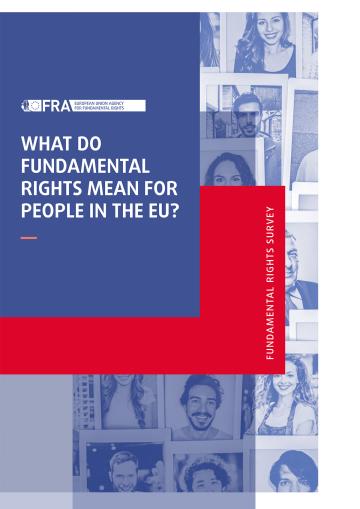
FRA’s Fundamental Rights Survey collected data from 35,000 people about their experiences, perceptions and opinions on a range of issues that are variously encompassed by human rights. This report presents a small selection of the survey results. It focuses on findings with respect to respondents’ opinions about human – or fundamental rights; their views and perceptions on the functioning of democratic societies – as a pillar on which human rights can flourish; and on their thoughts on and engagement with public services that have a duty to enforce human rights law and to protect people’s rights.
This document presents data from the FRA Fundamental Rights Survey. It includes data on opinions and experiences of people in the European Union (EU) linked to data protection and technology.
FRA’s Fundamental Rights Report 2020 reviews major developments in the field in 2019, identifying both achievements and areas of concern. It also presents FRA’s opinions on these developments, including a synopsis of the evidence supporting these opinions. This year’s focus chapter explores how to unlock the full potential of the EU Charter of Fundamental Rights.
The Coronavirus pandemic continues to interrupt everyday life in the EU in unprecedented ways. But the way it affects our societies is shifting. As governments gradually lift some of the measures put in place to contain the spread of COVID-19, new fundamental rights concerns arise: how to ensure that the rights to life and health are upheld as daily life transitions to a ‘new normal’. This Bulletin looks at declarations of states of emergency, or equivalent, and how they came under scrutiny. It considers the impact on fundamental rights in important areas of daily life, and includes a thematic focus on the processing of users’ data to help contain COVID-19, particularly by contact-tracing apps. It covers the period 21 March – 30 April 2020.
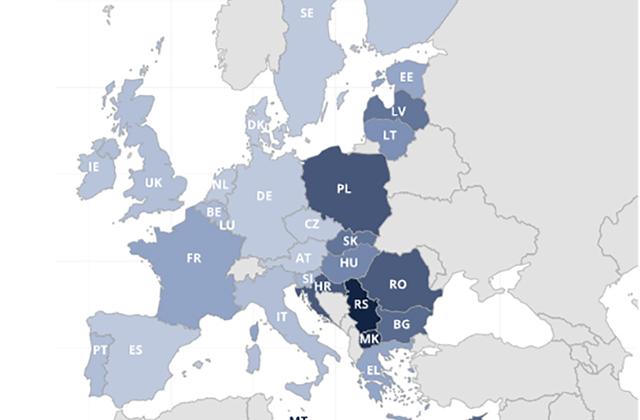
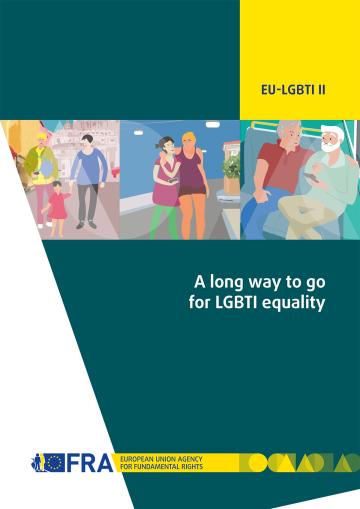
A total of 139,799 persons aged 15 years or older who describe themselves as lesbian, gay, bisexual, trans or intersex (LGBTI) completed the online EU-LGBTI II Survey in all EU Member States and the candidate countries of North Macedonia and Serbia.
This report presents select findings from FRA’s 2019 survey on LGBTI people in the EU and North Macedonia and Serbia. With almost 140,000 participants, it is the largest survey of its kind. It follows the agency’s first survey on LGBT people in the EU, conducted in 2012. The new survey results show little progress over the past seven years.
The outbreak of COVID-19 affects people’s daily life in the 27 EU Member States. As the number of infected people in the EU territory began to mount rapidly in February and March, governments put in place a raft of measures – often introduced in a period of only a few days – in an effort to contain the spread of the virus. Many of these measures reflect how, in exceptional emergency situations, the urgent need to save lives justifies restrictions on other rights, such as the freedom of movement and of assembly. This report outlines some of the measures EU Member States have put in place to protect public health during the COVID-19 pandemic. It covers the period 1 February – 20 March 2020.
Council of Europe (CoE) and European Union (EU) Member States have an undeniable sovereign right to control the entry of non-nationals into their territory. While exercising border control, states have a duty to protect the fundamental rights of all people under their jurisdiction, regardless of their nationality and/or legal status. Under EU law, this includes providing access to asylum procedures.
The EU Agency for Fundamental Rights (FRA) urges Member States to agree on a simple and practical workflow as soon as possible, to avoid lack of clarity and delays in the relocation process. This paper provides practical suggestions on relocation of unaccompanied children from Greece, building on lessons learned from previous mandatory and voluntary relocation schemes. The paper provides FRA input on the initiative of the European Commission and a group of Member States to relocate unaccompanied children.
Η παρούσα έκθεση εξετάζει πέντε βασικές πτυχές των συνθηκών κράτησης στα κράτη μέλη της ΕΕ: το μέγεθος των
κελιών, τον χρόνο που οι κρατούμενοι μπορούν να περνούν έξω από τα κελιά τους, συμπεριλαμβανομένων των εξω-
τερικών χώρων, τις συνθήκες υγιεινής, την πρόσβαση στην υγειονομική περίθαλψη και το αν οι κρατούμενοι προστα-
τεύονται από τη βία. Για καθεμία από αυτές τις πτυχές των συνθηκών κράτησης, η έκθεση συνοψίζει καταρχάς τα ελά-
χιστα πρότυπα σε διεθνές και ευρωπαϊκό επίπεδο. Στη συνέχεια εξετάζει πώς τα εν λόγω πρότυπα μετουσιώνονται σε
εθνικούς νόμους και άλλους κανόνες των κρατών μελών της ΕΕ.
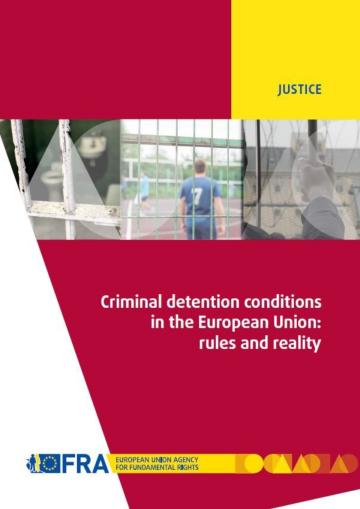
This report looks at five core aspects of detention conditions in EU Member States: the size of cells; the amount of time detainees can spend outside of these cells, including outdoors; sanitary conditions; access to healthcare; and whether detainees are protected from violence. For each of these aspects of detention conditions, the report first summarises the minimum standards at international and European levels. It then looks at how these standards are translated into national laws and other rules of the EU Member States.
Growing global efforts to encourage responsible business conduct that respects human rights include steps to ensure access to effective remedies when breaches occur. In 2017, the European Commission asked the EU Agency for Fundamental Rights (FRA) to collect evidence on such access in the EU Member States, with the ultimate goal of identifying the EU actions most needed in this field. FRA’s resulting research involved two phases: desk research on different incidents of abuse; and interview-based fieldwork on professionals’ views on the availability and effectiveness of different complaint avenues.
Over 2.5 million people applied for international protection in the 28 EU Member States in 2015 and 2016. Many of those who were granted some form of protection are young people, who are likely to stay and settle in the EU. The EU Agency for Fundamental Rights interviewed some of them, as well as professionals working with them in 15 locations across six EU Member States: Austria, France, Germany, Greece, Italy and Sweden. This report presents the result of FRA’s fieldwork research, focusing on young people between the
ages of 16 and 24.
Child rights come first. Measures to ensure child protection and participation apply to all children in the EU. This brochure guides you to relevant FRA reports and tools that can support you when promoting and protecting the rights of all children in the EU.