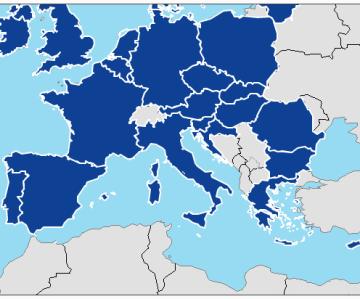
In 2019, the International Organization for Migration estimated that 1,866 people have died or gone missing while crossing the Mediterranean Sea to reach Europe to escape war or persecution or to pursue a better life. This is an average of five people per day. In recent years, a significant proportion of migrants in distress at sea have been rescued by civil society vessels deployed with a humanitarian mandate to reduce fatalities and bring rescued migrants to safety. Since 2018, however, authorities in some EU Member States started viewing civil society-deployed rescue vessels with hostility. As a reaction, national authorities initiated about 40 administrative and criminal proceedings against crew members or vessels, including seizing the latter. In some cases, rescue vessels were blocked in harbours due to flag issues or the inability to meet technical requirements.
This document presents data from the FRA Fundamental Rights Survey. It includes data on opinions and experiences of people in the European Union (EU) linked to data protection and technology.
FRA’s Fundamental Rights Report 2020 reviews major developments in the field in 2019, identifying both achievements and areas of concern. It also presents FRA’s opinions on these developments, including a synopsis of the evidence supporting these opinions. This year’s focus chapter explores how to unlock the full potential of the EU Charter of Fundamental Rights.
The EU Agency for Fundamental Rights has been regularly collecting data on migration since September 2015. This report focuses on the fundamental rights situation of people arriving in Member States and EU candidate countries particularly affected by large migration movements. It addresses key fundamental rights concerns between 1 January and 31 March 2020.
In recent years, thousands of girls and boys have reached Europe without their parents, and sought international protection. Many of them experienced violence, abuse and neglect in their home countries, and while in transit. They have the right to be protected in line with the provisions of the UN Convention on the Rights of the Child, the European Convention on Human Rights, and European Union law. This report explores the challenges and good practices gathered in the implementation of such relocation programmes. Based on information FRA collected in 10 EU Member States, it aims to help national authorities to support the relocation of unaccompanied children by taking measures that are fully rights compliant and practically feasible.
The outbreak of COVID-19 affects people’s daily life in the 27 EU Member States. As the number of infected people in the EU territory began to mount rapidly in February and March, governments put in place a raft of measures – often introduced in a period of only a few days – in an effort to contain the spread of the virus. Many of these measures reflect how, in exceptional emergency situations, the urgent need to save lives justifies restrictions on other rights, such as the freedom of movement and of assembly. This report outlines some of the measures EU Member States have put in place to protect public health during the COVID-19 pandemic. It covers the period 1 February – 20 March 2020.
Council of Europe (CoE) and European Union (EU) Member States have an undeniable sovereign right to control the entry of non-nationals into their territory. While exercising border control, states have a duty to protect the fundamental rights of all people under their jurisdiction, regardless of their nationality and/or legal status. Under EU law, this includes providing access to asylum procedures.
Тази брошура помага на служителите и органите да информират кандидатите за убежище и мигрантите по разбираем и достъпен начин относно обработката на техните пръстови отпечатъци в системата Евродак.
Tento leták má napomoci úředníkům a úřadům informovat žadatele o azyl a migranty srozumitelně a přístupnou cestou o zpracování jejich otisků prstů v systému Eurodac.
Denne folder hjælper grænsevagter og myndigheder med at informere asylansøgere og immigranter om behandlingen af deres fingeraftryk i Eurodac på en forståelig og lettilgængelig måde.
Dieses Merkblatt unterstützt Beamte und Behörden bei der verständlichen und anschaulichen Information von Asylbewerbern und Migranten über die Verarbeitung ihrer Fingerabdrücke in Eurodac.
Το παρόν φυλλάδιο βοηθά τους αρμόδιους υπαλλήλους και τις αρχές να ενημερώνουν με εύκολο και απλό τρόπο τους αιτούντες άσυλο και τους μετανάστες σχετικά με την επεξεργασία των δακτυλικών τους αποτυπωμάτων στο Eurodac.
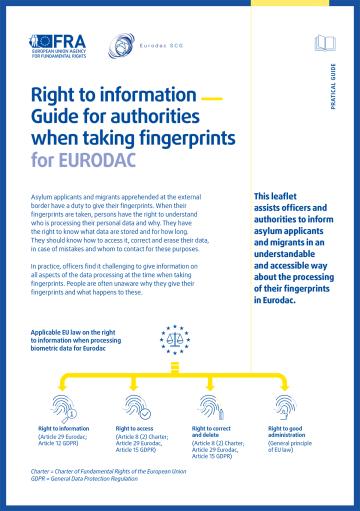
This leaflet assists officers and authorities to inform asylum applicants and migrants in an understandable and accessible way about the processing of their fingerprints in Eurodac.
Este folleto ayuda a los funcionarios y a las autoridades a informar a los solicitantes de asilo y a los inmigrantes, de un modo comprensible y accesible, sobre el tratamiento de sus huellas dactilares en Eurodac.
See teabeleht aitab ametnikel ja ametiasutustel teavitada varjupaigataotlejaid ning rändajaid arusaadaval ja kättesaadaval viisil nende sõrmejälgede töötlemisest Eurodac-süsteemis.
Tämä esite auttaa virkamiehiä ja viranomaisia kertomaan turvapaikanhakijoille ja maahanmuuttajille ymmärrettävällä ja helposti saavutettavalla tavalla sormenjälkien käsittelystä Eurodacissa.
Ce dépliant aide les agents et les autorités à informer de manière compréhensible et accessible les demandeurs d’asile et les migrants sur le traitement de leurs empreintes digitales dans Eurodac.
Ovaj letak pomaže službenicima i nadležnim tijelima da na razumljiv i pristupačan način obavijeste podnositelje zahtjeva za azil i migrante o obradi njihovih otisaka prstiju u Eurodacu.
Ez a szóróanyag támogatja a hatóságok dolgozóit abban, hogy közérthető és hozzáférhető módon tudják tájékoztatni a bevándorlókat és menedékkérőket az ujjlenyomataik Eurodac általi feldolgozásáról.
Questa breve guida intende supportare gli operatori e le autorità nel fornire informazioni comprensibili e accessibili ai richiedenti asilo e ai migranti rispetto al trattamento delle impronte digitali in Eurodac.