eu-charter

Charte des droits fondamentaux de l'Union européenne

Article 3 - Droit à l'intégrité de la personne

Article 3 - Droit à l'intégrité de la personne

1. Toute personne a droit à son intégrité physique et mentale.

2. Dans le cadre de la médecine et de la biologie, doivent notamment être respectés:

a) le consentement libre et éclairé de la personne concernée, selon les modalités définies par la loi;

b) l'interdiction des pratiques eugéniques, notamment celles qui ont pour but la sélection des personnes;

c) l'interdiction de faire du corps humain et de ses parties, en tant que tels, une source de profit;

d) l'interdiction du clonage reproductif des êtres humains.

Explications

  • Texte:

    1. Dans son arrêt du 9 octobre 2001 dans l'affaire C-377/98, Pays-Bas contre Parlement européen et Conseil, rec. 2001, p. I-7079, points 70, 78, 79 et 80, la Cour de justice a confirmé que le droit fondamental à l'intégrité de la personne fait partie du droit de l'Union et comprend, dans le cadre de la médecine et de la biologie, le consentement libre et éclairé du donneur et du receveur.
    2. Les principes contenus dans l'article 3 de la Charte figurent déjà dans la convention sur les droits de l'homme et la biomédecine, adoptée dans le cadre du Conseil de l'Europe (STE 164 et protocole additionnel STE 168). La présente Charte ne vise pas à déroger à ces dispositions et ne prohibe en conséquence que le seul clonage reproductif. Elle n'autorise ni ne prohibe les autres formes de clonage. Elle n'empêche donc aucunement le législateur d'interdire les autres formes de clonages.
    3. La référence aux pratiques eugéniques, notamment celles ayant pour but la sélection des personnes, vise les hypothèses dans lesquelles des programmes de sélection sont organisés et mis en œuvre, comportant par exemple des campagnes de stérilisation, de grossesses forcées, de mariages ethniques obligatoires… tous actes qui sont considérés comme des crimes internationaux par le statut de la Cour pénale internationale adopté à Rome le 17 juillet 1998 (voir article 7, paragraphe 1, point g).

    Source:
    Journal officiel de l'Union européenne C 303/17 - 14.12.2007
    Preamble - Explanations relating to the Charter of Fundamental Rights:
    Les explications qui figurent ci-après ont été établies initialement sous la responsabilité du praesidium de la Convention qui a élaboré la Charte des droits fondamentaux de l'Union européenne. Elles ont été mises à jour sous la responsabilité du praesidium de la Convention européenne, compte tenu des adaptations apportées au texte de la Charte par ladite Convention (notamment aux articles 51 et 52) et de l'évolution du droit de l'Union. Bien que ces explications n'aient pas en soi de valeur juridique, elles constituent un outil d'interprétation précieux destiné à éclairer les dispositions de la Charte.

Références à la jurisprudence

Droit constitutionnel national

36 results found

  • Lietuvos Respublikos Konstitucija
    Pays:
    Lithuania

    21 straipsnis. (...) Su žmogumi, be jo žinios ir laisvo sutikimo, negali būti atliekami moksliniai ar medicinos bandymai.

  • Luxembourg / Constitution du Grand-Duché de Luxembourg
    Pays:
    Luxembourg

    Art. 13. (1) Toute personne a droit à son intégrité physique et mentale.

  • Magyarország Alaptörvénye
    Pays:
    Hungary

    II. cikk (SZABADSÁG ÉS FELELŐSSÉG) Az emberi méltóság sérthetetlen. Minden embernek joga van az élethez és az emberi méltósághoz [...] III. cikk (SZABADSÁG ÉS FELELŐSSÉG)(1) [...] Tilos az emberkereskedelem. (2) Tilos emberen tájékoztatáson alapuló, önkéntes hozzájárulása nélkül orvosi vagy tudományos kísérletet végezni. (3) Tilos az emberi fajnemesítést célzó gyakorlat, az emberi test és testrészek haszonszerzési célú felhasználása, valamint az emberi egyedmásolás.

  • Netherlands / Constitution of the Kingdom of the Netherlands
    Pays:
    Netherlands

    Article 11 Everyone shall have the right to inviolability of his person, without prejudice to restrictions laid down by or pursuant to Act of Parliament.

  • Portugal / Constitution of the Portuguese Republic
    Pays:
    Portugal

    Article 25 (Right to personal integrity) (1) Every person’s moral and physical integrity is inviolable. (2) No one may be subjected to torture or to cruel, degrading or inhuman treatment or punishment.

    Article 26 (Other personal rights) (3) The law shall guarantee the personal dignity and genetic identity of the human person, particularly in the creation, development and use of technologies and in scientific experimentation.

  • Romania / Constitution of Romania
    Pays:
    Romania

    Article 22(1) The right to life, as well as the right to physical and mental integrity of person are guaranteed. (...)

  • Slovakia / Constitution of the Slovak Republic
    Pays:
    Slovakia

    Article 16( 1) The right of every individual to integrity and privacy shall be guaranteed. This right may be restricted only in cases specifically provided by a law.

  • Slovenia / Constitution of the Republic of Slovenia
    Pays:
    Slovenia

    Article 18 No one may be subjected to torture, inhuman or degrading punishment or treatment. The conducting of medical or other scientific experiments on any person without his free consent is prohibited.

    Article 35 The inviolability of the physical and mental integrity of every person, his privacy and personality rights shall be guaranteed.

  • Spain / Constitution of the Kingdom of Spain
    Pays:
    Spain

    Article 15 Everyone has the right to life and to physical and moral integrity, and under no circumstances may be subjected to torture or to inhuman or degrading punishment or treatment. Death penalty is hereby abolished, except as provided for by military criminal law in times of war.

  • Suomen perustuslaki
    Pays:
    Finland

    7 § Oikeus elämään sekä henkilökohtaiseen vapauteen ja koskemattomuuteen Jokaisella on oikeus elämään sekä henkilökohtaiseen vapauteen, koskemattomuuteen ja turvallisuuteen. Ketään ei saa tuomita kuolemaan, kiduttaa eikä muutoinkaan kohdella ihmisarvoa loukkaavasti. Henkilökohtaiseen koskemattomuuteen ei saa puuttua eikä vapautta riistää mielivaltaisesti eikä ilman laissa säädettyä perustetta. Rangaistuksen, joka sisältää vapaudenmenetyksen, määrää tuomioistuin. (...)

  • The Belgian Constitution
    Pays:
    Belgium

    Article 22bis.Each child is entitled to have his or her moral, physical, mental and sexual integrity respected.(.....)

  • The Constitution of the Republic of Cyprus
    Pays:
    Cyprus

    Article 7
    1. Every person has the right to life and corporal integrity.
    2. [Deleted]
    3. Deprivation of life shall not be regarded as inflicted in contravention of this Article when it results from the use of force which is no more than absolutely necessary -
    (a) in defence of person or property against the infliction of aproportionate and otherwise unavoidable and irreparable evil;
    (b) in order to effect an arrest or to prevent the escape of a person lawfully detained;
    (c) in action taken for the purpose of quelling a riot or insurrection.

  • The Fundamental Law of Hungary
    Pays:
    Hungary

    Article II (Freedom and Responsibility) Human dignity shall be inviolable. Every human being shall have the right to life and human dignity [...] Article III (Freedom and Responsibility) (1) [...] Trafficking in human beings shall be prohibited. (2) It shall be prohibited to perform medical or scientific experiment on human beings without their informed and voluntary consent. (3) Practices aimed at eugenics and the use of the human body or its parts for financial gain, as well as human cloning shall be prohibited.

  • Tο Σύνταγμα της Κυπριακής Δημοκρατίας
    Pays:
    Cyprus

    ΑΡΘΡΟΝ 7
    1. Έκαστος έχει το δικαίωμα ζωής και σωματικής ακεραιότητος.
    2. [Διαγράφηκε].
    3. Η αποστέρησης της ζωής δεν θεωρείται παράβασις του παρόντος άρθρου, οσάκις προέρχεται εκ της χρήσεως της απολύτως αναγκαίας βίας, ότε και όπως ο νόμος ορίζη:
    (α) επί αμύνης προσώπου ή περιουσίας προς αποτροπήν αναλόγου και άλλως αναποτρέπτου και ανεπανορθώτου κακού,
    (β) προς διενέργειαν συλλήψεως ή προς παρεμπόδισιν αποδράσεως προσώπου νομίμως κρατουμένου,
    (γ) επί πράξεως γενομένης προς σκοπόν καταστολής ταραχών ή στάσεως.

  • Το Σύνταγμα της Ελλάδας
    Pays:
    Greece

    Άρθρο 5(2). Όλoι όσoι βρίσκoνται στην Eλληνική Eπικράτεια απoλαμβάνoυν την απόλυτη πρoστασία της ζωής, της τιμής και της ελευθερίας τoυς, χωρίς διάκριση εθνικότητας, φυλής, γλώσσας και θρησκευτικών ή πoλιτικών πεπoιθήσεων. Eξαιρέσεις επιτρέπoνται στις περιπτώσεις πoυ πρoβλέπει τo διεθνές δίκαιo [...]

  • КОНСТИТУЦИЯ на Република България
    Pays:
    Bulgaria

    Чл. 29. [...] (2) Никой не може да бъде подлаган на медицински, научни или други опити без неговото доброволно писмено съгласие.Чл. 52. [...] (4) Никой не може да бъде подлаган принудително на лечение и на санитарни мерки освен в предвидените от закона случаи.

Droit de l'UE

5 results found

  • Council Directive 2004/81/EC of 29 April 2004 on the residence permit issued to third-country nationals who are victims of trafficking in human beings or who have been the subject of an action to facilitate illegal immigration, who cooperate with the comp

    Preamble


    (9) This Directive introduces a residence permit intended for victims of trafficking in human beings or, if a Member State decides to extend the scope of this Directive, to third-country nationals who have been the subject of an action to facilitate illegal immigration to whom the residence permit offers a sufficient incentive to cooperate with the competent authorities while including certain conditions to safeguard against abuse.


    Article 1: Purpose

    The purpose of this Directive is to define the conditions for granting residence permits of limited duration, linked to the length of the relevant national proceedings, to third-country nationals who cooperate in the fight against trafficking in human beings or against action to facilitate illegal immigration.

  • Directive 2013/32/EU of the European Parliament and of the Council of 26 June 2013 on common procedures for granting and withdrawing international protection (recast)

    Preamble 
    (33) The best interests of the child should be a primary consideration of Member States when applying this Directive, in accordance with the Charter of Fundamental Rights of the European Union (the Charter) and the 1989 United Nations Convention on the Rights of the Child. In assessing the best interest of the child, Member States should in particular take due account of the minor’s well-being and social development, including his or her background.

    (39) In determining whether a situation of uncertainty prevails in the country of origin of an applicant, Member States should ensure that they obtain precise and up-to-date information from relevant sources such as EASO, UNHCR, the Council of Europe and other relevant international organisations. Member States should ensure that any postponement of conclusion of the procedure fully complies with their obligations under Directive 2011/95/EU and Article 41 of the Charter, without prejudice to the efficiency and fairness of the procedures under this Directive.


    (60) This Directive respects the fundamental rights and observes the principles recognised by the Charter. In particular, this Directive seeks to ensure full respect for human dignity and to promote the application of Articles 1, 4, 18, 19, 21, 23, 24, and 47 of the Charter and has to be implemented accordingly.

    Article 13: Obligations of the applicants

    1. Member States shall impose upon applicants the obligation to cooperate with the competent authorities with a view to establishing their identity and other elements referred to in Article 4(2) of Directive 2011/95/EU. Member States may impose upon applicants other obligations to cooperate with the competent authorities insofar as such obligations are necessary for the processing of the application.

    2. In particular, Member States may provide that:

    (a) applicants are required to report to the competent authorities or to appear before them in person, either without delay or at a specified time;

    (b) applicants have to hand over documents in their possession relevant to the examination of the application, such as their passports;

    (c) applicants are required to inform the competent authorities of their current place of residence or address and of any changes thereof as soon as possible. Member States may provide that the applicant shall have to accept any communication at the most recent place of residence or address which he or she indicated accordingly;

    (d) the competent authorities may search the applicant and the items which he or she is carrying. Without prejudice to any search carried out for security reasons, a search of the applicant’s person under this Directive shall be carried out by a person of the same sex with full respect for the principles of human dignity and of physical and psychological integrity;

    (e) the competent authorities may take a photograph of the applicant; and

    (f) the competent authorities may record the applicant’s oral statements, provided he or she has previously been informed thereof.

    ...

    Article 30: Collection of information on individual cases

    For the purposes of examining individual cases, Member States shall not:

    (a) disclose information regarding individual applications for international protection, or the fact that an application has been made, to the alleged actor(s) of persecution or serious harm;

    (b) obtain any information from the alleged actor(s) of persecution or serious harm in a manner that would result in such actor(s) being directly informed of the fact that an application has been made by the applicant in question, and would jeopardise the physical integrity of the applicant or his or her dependants, or the liberty and security of his or her family members still living in the country of origin.

    ...

    Article 45: Procedural rules

    1. Member States shall ensure that, where the competent authority is considering withdrawing international protection from a third-country national or stateless person in accordance with Article 14 or 19 of Directive 2011/95/EU, the person concerned enjoys the following guarantees:

    (a) to be informed in writing that the competent authority is reconsidering his or her qualification as a beneficiary of international protection and the reasons for such a reconsideration; and

    (b) to be given the opportunity to submit, in a personal interview in accordance with Article 12(1)(b) and Articles 14 to 17 or in a written statement, reasons as to why his or her international protection should not be withdrawn.

    2. In addition, Member States shall ensure that within the framework of the procedure set out in paragraph 1:

    (a) the competent authority is able to obtain precise and up-to-date information from various sources, such as, where appropriate, from EASO and UNHCR, as to the general situation prevailing in the countries of origin of the persons concerned; and

    (b) where information on an individual case is collected for the purposes of reconsidering international protection, it is not obtained from the actor(s) of persecution or serious harm in a manner that would result in such actor(s) being directly informed of the fact that the person concerned is a beneficiary of international protection whose status is under reconsideration, or jeopardise the physical integrity of the person or his or her dependants, or the liberty and security of his or her family members still living in the country of origin.

    3. Member States shall ensure that the decision of the competent authority to withdraw international protection is given in writing. The reasons in fact and in law shall be stated in the decision and information on how to challenge the decision shall be given in writing.

    4. Once the competent authority has taken the decision to withdraw international protection, Article 20, Article 22, Article 23(1) and Article 29 are equally applicable.

    5. By way of derogation from paragraphs 1 to 4 of this Article, Member States may decide that international protection shall lapse by law where the beneficiary of international protection has unequivocally renounced his or her recognition as such. A Member State may also provide that international protection shall lapse by law where the beneficiary of international protection has become a national of that Member State. 

  • Directive (EU) 2017/541 of the European Parliament and of the Council of 15 March 2017 on combating terrorism and replacing Council Framework Decision 2002/475/JHA and amending Council Decision 2005/671/JHA

    Article 3

    Terrorist offences

    1. Member States shall take the necessary measures to ensure that the following intentional acts, as defined as offences under national law, which, given their nature or context, may seriously damage a country or an international organisation, are defined as terrorist offences where committed with one of the aims listed in paragraph 2:

    (a) attacks upon a person’s life which may cause death;

    (b) attacks upon the physical integrity of a person;

    (c) kidnapping or hostage-taking;

    (d) causing extensive destruction to a government or public facility, a transport system, an infrastructure facility, including an information system, a fixed platform located on the continental shelf, a public place or private property likely to endanger human life or result in major economic loss;

    (e) seizure of aircraft, ships or other means of public or goods transport;

    (f) manufacture, possession, acquisition, transport, supply or use of explosives or weapons, including chemical, biological, radiological or nuclear weapons, as well as research into, and development of, chemical, biological, radiological or nuclear weapons;

    (g) release of dangerous substances, or causing fires, floods or explosions, the effect of which is to endanger human life;

    (h) interfering with or disrupting the supply of water, power or any other fundamental natural resource, the effect of which is to endanger human life;

    (i) illegal system interference, as referred to in Article 4 of Directive 2013/40/EU of the European Parliament and of the Council (19) in cases where Article 9(3) or point (b) or (c) of Article 9(4) of that Directive applies, and illegal data interference, as referred to in Article 5 of that Directive in cases where point (c) of Article 9(4) of that Directive applies;

    (j) threatening to commit any of the acts listed in points (a) to (i).

    2. The aims referred to in paragraph 1 are:

    (a) seriously intimidating a population;

    (b) unduly compelling a government or an international organisation to perform or abstain from performing any act;

    (c) seriously destabilising or destroying the fundamental political, constitutional, economic or social structures of a country or an international organisation.

  • Regulation (EU) No 536/2014 of the European Parliament and of the Council of 16 April 2014 on clinical trials on medicinal products for human use, and repealing Directive 2001/20/EC Text with EEA relevance

    Article 28 General rules

    1. A clinical trial may be conducted only where all of the following conditions are met:

    (a) the anticipated benefits to the subjects or to public health justify the foreseeable risks and inconveniences and compliance with this condition is constantly monitored;

    (b) the subjects, or where a subject is not able to give informed consent, his or her legally designated representative, have been informed in accordance with Article 29(2) to (6);

    (c) the subjects, or where a subject is not able to give informed consent, his or her legally designated representative, have given informed consent in accordance with Article 29(1), (7) and (8);

    (d) the rights of the subjects to physical and mental integrity, to privacy and to the protection of the data concerning them in accordance with Directive 95/46/EC are safeguarded;

  • Directive 2012/29/EU of the European Parliament and of the Council of 25 October 2012 establishing minimum standards on the rights, support and protection of victims of crime, and replacing Council Framework Decision 2001/220/JHA

    Preamble:

    (14) In applying this Directive, children's best interests must be a primary consideration, in accordance with the Charter of Fundamental Rights of the European Union and the United Nations Convention on the Rights of the Child adopted on 20 November 1989. Child victims should be considered and treated as the full bearers of rights set out in this Directive and should be entitled to exercise those rights in a manner that takes into account their capacity to form their own views.
    (16) Victims of terrorism have suffered attacks that are intended ultimately to harm society. They may therefore need special attention, support and protection due to the particular nature of the crime that has been committed against them. Victims of terrorism can be under significant public scrutiny and often need social recognition and respectful treatment by society. Member States should therefore take particular account of the needs of victims of terrorism, and should seek to protect their dignity and security.’
    ‘(38) [...] A main task of these services and their staff, which play an important role in supporting the victim to recover from and overcome potential harm or trauma as a result of a criminal offence, should be to inform victims about the rights set out in this Directive so that they can take decisions in a supportive environment that treats them with dignity, respect and sensitivity. The types of support that such specialist support services should offer could include providing shelter and safe accommodation, immediate medical support, referral to medical and forensic examination for evidence in cases of rape or sexual assault, short and long-term psychological counselling, trauma care, legal advice, advocacy and specific services for children as direct or indirect victims.’
    ‘(52) Measures should be available to protect the safety and dignity of victims and their family members from secondary and repeat victimisation, from intimidation and from retaliation, such as interim injunctions or protection or restraining orders.’

    (66) This Directive respects fundamental rights and observes the principles recognised by the Charter of Fundamental Rights of the European Union. In particular, it seeks to promote the right to dignity, life, physical and mental integrity, liberty and security, respect for private and family life, the right to property, the principle of non-discrimination, the principle of equality between women and men, the rights of the child, the elderly and persons with disabilities, and the right to a fair trial.

    Article 18 - Right to protection
    ‘Without prejudice to the rights of the defence, Member States shall ensure that measures are available to protect victims and their family members from secondary and repeat victimisation, from intimidation and from retaliation, including against the risk of emotional or psychological harm, and to protect the dignity of victims during questioning and when testifying. When necessary, such measures shall also include procedures established under national law for the physical protection of victims and their family members.’

Droit international

6 results found

  • Council of Europe Convention against Trafficking in Human Organs

    Article 4 – Illicit removal of human organs

    1 Each Party shall take the necessary legislative and other measures to establish as a criminal offence under its domestic law, when committed intentionally, the removal of human organs from living or deceased donors:

    a where the removal is performed without the free, informed and specific consent of the living or deceased donor, or, in the case of the deceased donor, without the removal being authorised under its domestic law;

    b where, in exchange for the removal of organs, the living donor, or a third party, has been offered or has received a financial gain or comparable advantage; 

    c where in exchange for the removal of organs from a deceased donor, a third party has been offered or has received a financial gain or comparable advantage.

    2 Any State or the European Union may, at the time of signature or when depositing its instrument of ratification, acceptance or approval, by a declaration addressed to the Secretary General of the Council of Europe, declare that it reserves the right not to apply paragraph 1. a of this article to the removal of human organs from living donors, in exceptional cases and in accordance with appropriate safeguards or consent provisions under its domestic law. Any reservation made under this paragraph shall contain a brief statement of the relevant domestic law.

    3 The expression “financial gain or comparable advantage” shall, for the purpose of paragraph 1, b and c, not include compensation for loss of earnings and any other justifiable expenses caused by the removal or by the related medical examinations, or compensation in case of damage which is not inherent to the removal of organs.

    4 Each Party shall consider taking the necessary legislative or other measures to establish as a criminal offence under its domestic law the removal of human organs from living or deceased donors where the removal is performed outside of the framework of its domestic transplantation system, or where the removal is performed in breach of essential principles of national transplantation laws or rules. If a Party establishes criminal offences in accordance with this provision, it shall endeavour to apply also Articles 9 to 22 to such offences.

  • Convention for the Protection of Human Rights and Dignity of the Human Being with regard to the Application of Biology and Medicine

    Article 1 – Purpose and object

    Parties to this Convention shall protect the dignity and identity of all human beings and guarantee everyone, without discrimination, respect for their integrity and other rights and fundamental freedoms with regard to the application of biology and medicine.

    Each Party shall take in its internal law the necessary measures to give effect to the provisions of this Convention.

    ...

  • Rome Statute of the International Criminal Court

    Article 7 Crimes against humanity

    1. For the purpose of this Statute, "crime against humanity" means any of the following acts when committed as part of a widespread or systematic attack directed against any civilian population, with knowledge of the attack:

    (a) Murder;

    (b) Extermination;

    (c) Enslavement;

    (d) Deportation or forcible transfer of population;

    (e) Imprisonment or other severe deprivation of physical liberty in violation of fundamental rules of international law;

    (f) Torture;

    (g) Rape, sexual slavery, enforced prostitution, forced pregnancy, enforced sterilization, or any other form of sexual violence of comparable gravity;

    (h) Persecution against any identifiable group or collectivity on political, racial, national, ethnic, cultural, religious, gender as defined in paragraph 3, or other grounds that are universally recognized as impermissible under international law, in connection with any act referred to in this paragraph or any crime within the jurisdiction of the Court;

    (i) Enforced disappearance of persons;

    (j) The crime of apartheid;

    (k) Other inhumane acts of a similar character intentionally causing great suffering, or serious injury to body or to mental or physical health.

    2. For the purpose of paragraph 1:

    (a) "Attack directed against any civilian population" means a course of conduct involving the multiple commission of acts referred to in paragraph 1 against any civilian population, pursuant to or in furtherance of a State or organizational policy to commit such attack;

    (b) "Extermination" includes the intentional infliction of conditions of life, inter alia the deprivation of access to food and medicine, calculated to bring about the destruction of part of a population;

    (c) "Enslavement" means the exercise of any or all of the powers attaching to the right of ownership over a person and includes the exercise of such power in the course of trafficking in persons, in particular women and children;

    (d) "Deportation or forcible transfer of population" means forced displacement of the persons concerned by expulsion or other coercive acts from the area in which they are lawfully present, without grounds permitted under international law;

    (e) "Torture" means the intentional infliction of severe pain or suffering, whether physical or mental, upon a person in the custody or under the control of the accused; except that torture shall not include pain or suffering arising only from, inherent in or incidental to, lawful sanctions;

    (f) "Forced pregnancy" means the unlawful confinement of a woman forcibly made pregnant, with the intent of affecting the ethnic composition of any population or carrying out other grave violations of international law. This definition shall not in any way be interpreted as affecting national laws relating to pregnancy;

    (g) "Persecution" means the intentional and severe deprivation of fundamental rights contrary to international law by reason of the identity of the group or collectivity;

    (h) "The crime of apartheid" means inhumane acts of a character similar to those referred to in paragraph 1, committed in the context of an institutionalized regime of systematic oppression and domination by one racial group over any other racial group or groups and committed with the intention of maintaining that regime;

    (i) "Enforced disappearance of persons" means the arrest, detention or abduction of persons by, or with the authorization, support or acquiescence of, a State or a political organization, followed by a refusal to acknowledge that deprivation of freedom or to give information on the fate or whereabouts of those persons, with the intention of removing them from the protection of the law for a prolonged period of time.

    3. For the purpose of this Statute, it is understood that the term "gender" refers to the two sexes, male and female, within the context of society. The term "gender" does not indicate any meaning different from the above.

  • International Covenant on Civil and Political Rights

    Article 7

    No one shall be subjected to torture or to cruel, inhuman or degrading treatment or punishment. In particular, no one shall be subjected without his free consent to medical or scientific experimentation.

  • Additional Protocol to the Convention on Human Rights and Biomedicine, concerning Genetic Testing for Health Purposes

    Article 1 – Object and purpose

    Parties to this Protocol shall protect the dignity and identity of all human beings and guarantee everyone, without discrimination, respect for their integrity and other rights and fundamental freedoms with regard to the tests to which this Protocol applies in accordance with Article 2.

    ...

  • Convention on the Rights of Persons with Disabilities - Article 17

    Article 17 – Protecting the integrity of the person

    Every person with disabilities has a right to respect for his or her physical and mental integrity on an equal basis with others.

Produits

  • Fundamental Rights Report
    30
    mai
    2016
    Ce « Focus » examine de façon approfondie les questions de l’asile et de la
    migration dans l’Union européenne (UE) en 2015. Il se penche sur l’efficacité des mesures prises ou proposées par l’UE et
    ses États membres pour gérer cette situation, en se concentrant en particulier sur le respect des droits fondamentaux.
  • Easy-to-read report
    2
    décembre
    2015
    This book will tell you about violence and children with disabilities. It looks at violence, where it happens, and why people are violent.
  • Report / Paper / Summary
    2
    décembre
    2015
    Children with disabilities face significant barriers to enjoying their fundamental rights. They are often excluded from society, sometimes living in facilities far from their families. They are also denied access to basic services, such as health care and education, and endure stigma and discrimination, as well as sexual, physical and psychological violence. FRA scrutinised the important but underreported issue of violence against children with disabilities, carrying out desk research and conducting interviews with knowledgeable stakeholders. This report presents the results of that research.
  • Rapport / Publication / Résumé
    2
    décembre
    2015
    Les enfants handicapés rencontrent d’importants obstacles qui les empêchent de jouir de
    leurs droits fondamentaux. Ils sont souvent exclus de la société et vivent parfois dans des
    structures loin de leur famille. Ils se voient également refuser l’accès à des services de base,
    tels que les soins de santé et l’éducation, et sont confrontés à la stigmatisation et la discrimination,
    ainsi qu’à des violences sexuelles, physiques et psychologiques.Il expose les normes internationales et européennes pertinentes
    et examine les lois et politiques nationales consacrées à la violence envers les enfants
    handicapés. Il fait également état de l’ampleur et des multiples causes, cadres et formes de
    telles violences, et présente des mesures et des initiatives visant à les prévenir.
  • Report / Paper / Summary
    12
    mai
    2015
    This paper examines the legal situation of intersex people from a fundamental rights perspective. It draws on evidence from the Agency’s updated legal analysis on homophobia, transphobia, and discrimination on grounds of sexual orientation and gender identity, which now includes a section on intersex issues.
  • Rapport / Publication / Résumé
    12
    mai
    2015
    Les personnes trans, ou celles dont l’identité et/ou l’expression de genre diffère du sexe qui leur a été attribué à la naissance, sont souvent victimes de discrimination, de harcèlement et de violence dans l’Union européenne (UE) aujourd’hui. Cette réalité engendre des peurs qui peuvent pousser un grand nombre d’entre elles à cacher ou masquer leur vraie identité. Le présent rapport se penche sur l’égalité de traitement et sur la discrimination fondée sur deux motifs : l’orientation sexuelle et l’identité de genre.
  • Report / Paper / Summary
    9
    décembre
    2014
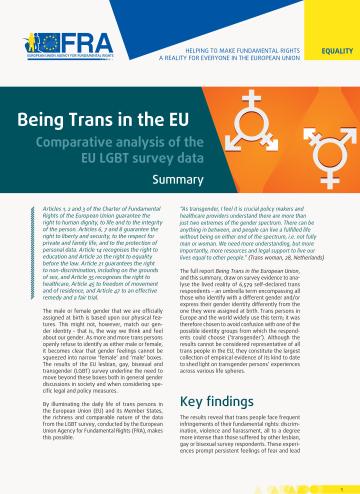
    Trans persons, or those whose gender identity and/or gender expression differs from the sex assigned them at birth, face frequent discrimination, harassment and violence across the European Union (EU) today. This reality triggers fears that persuade many to hide or disguise their true selves. This report examines issues of equal treatment and discrimination on two grounds, namely sexual orientation and gender identity. It analyses data on the experiences of 6,579 trans respondents from the EU Lesbian, gay, bisexual and transgender (LGBT) survey, the largest body of empirical evidence of its kind to date.
  • Report / Paper / Summary
    5
    mars
    2014
    This FRA survey is the first of its kind on violence against women across the 28 Member States of the European Union (EU). It is based on interviews with 42,000 women across the EU, who were asked about their experiences of physical, sexual and psychological violence, including incidents of intimate partner violence (‘domestic violence’).
  • Rapport / Publication / Résumé
    5
    mars
    2014
    La violence à l’égard des femmes est une violation des droits fondamentaux en matière de dignité, d’égalité et d’accès à la justice. Les résultats de l’enquête indiquent qu’une femme sur trois a subi au moins une forme de violence physique et/ou sexuelle depuis l’âge de 15 ans, une femme sur cinq a fait l’objet d’une traque furtive (« stalking »), et une femme sur deux a déjà été victime d’une ou de plusieurs formes de harcèlement sexuel.
    FRA
  • Report / Paper / Summary
    décembre
    2013
    The Fundamental Rights Conference 2013 was organised by the European Union Agency for Fundamental Rights (FRA) in cooperation with the Lithuanian Presidency of the Council of the EU. The focus of the conference was on the issue of ‘Combating hate crime in the EU’.