Newsroom

Two days of stimulating discussions, over 145 different sessions, 6 locations – that was the Fundamental Rights Forum 2021 in a nutshell. With over 3,000 people joining the Forum in Vienna and online, it was the biggest human rights event in Europe this year.
FRA will present its research findings during a side meeting at the UN Crime Congress. It will draw on results from its violence against women survey and fundamental rights survey.
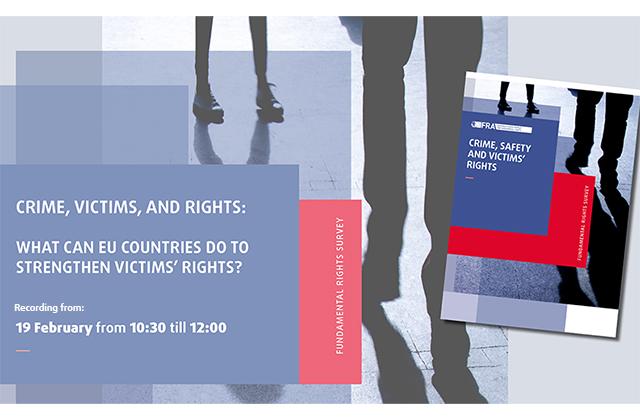
Crime can touch any of us – as witnesses or as victims. But no matter who you are, we all have rights when it comes to justice. It is for this reason that the European Union Agency for Fundamental Rights asked 35,000 people across Europe about their experiences of crime in its Fundamental Rights Survey, and the results are in.
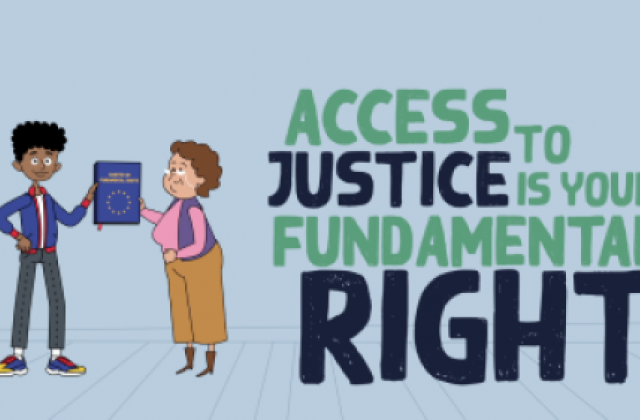
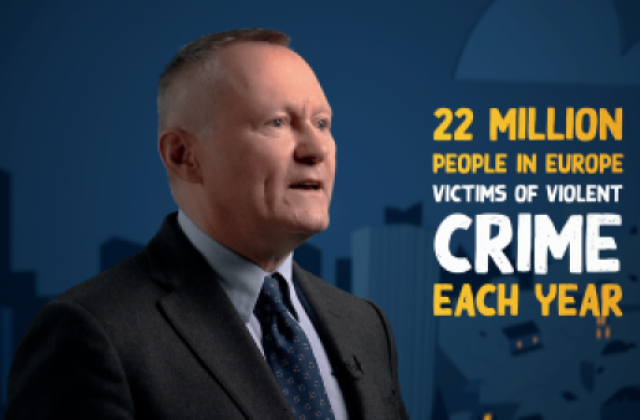
We don’t all experience crime in the same way, and we might deal with it differently. But it’s vital – as victims or witnesses – that our rights are guaranteed, because access to justice is our fundamental right. Watch FRA Director Michael O’Flaherty speaking on the Fundamental Rights Survey report on crime, safety and victims’ rights.
Vidéo
In his latest vlog FRA Director Michael O'Flaherty calls for making Covid-19 vaccine equality a top priority for 2021.
En l’espace d’un an, plus d’un Européen sur quatre a été victime de harcèlement et 22 millions d’Européens ont été agressés physiquement. Cependant, en général, les victimes de ces crimes ne les signalent pas. Elles ont souvent des difficultés à faire valoir leurs droits et peuvent se sentir dans l’impossibilité de s’exprimer. Tels sont les résultats de la toute première enquête menée à l’échelle de l’UE sur l’expérience de la population générale en matière de crimes, réalisée par l’Agence des droits fondamentaux de l'UE (FRA). Ils montrent comment des mesures ciblées peuvent aider les gouvernements à soutenir les victimes et à faciliter le signalement des crimes et l’accès à la justice.
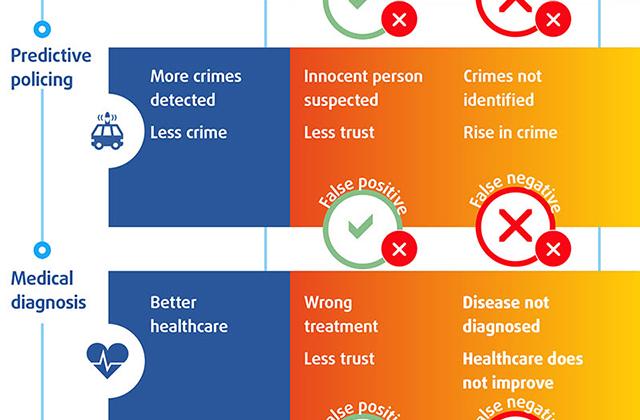
Artificial intelligence (AI) already plays a role in many decisions that affect our daily lives. From deciding what unemployment benefits someone gets to where a burglary is likely to take place. But we need to make sure to fully uphold fundamental rights standards when using AI. Drawing on the ‘Getting the future right – Artificial intelligence and fundamental rights’ report, FRA explores the potential benefits and possible errors that can occur focusing on four core areas – social benefits, predictive policing, health services and targeted advertising.
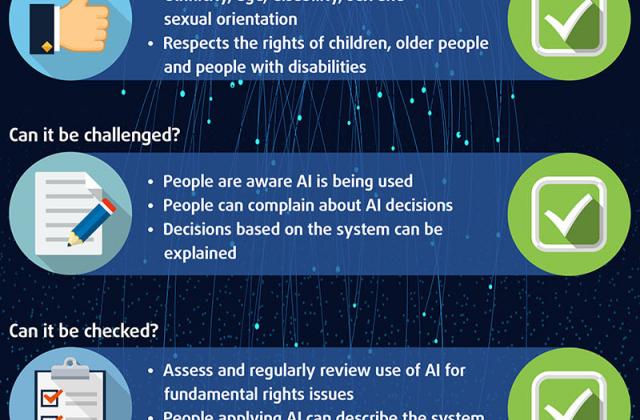
Artificial intelligence (AI) already plays a role in many decisions that affect our daily lives. From deciding what unemployment benefits someone gets to where a burglary is likely to take place. But we need to make sure to fully uphold fundamental rights standards when using AI. Drawing on the ‘Getting the future right – Artificial intelligence and fundamental rights’ report, FRA presents a number of key considerations to help businesses and administrations respect fundamental rights when using AI.
This is a recording from the afternoon session of the high-level virtual event "Doing Artificial Intelligence the European way" which took place on 14 December 2020.
This is a recording from the morning session of the high-level virtual event "Doing Artificial Intelligence the European way" which took place on 14 December 2020.
Key statements from the FRA/Euractiv online event Reinforcing the EU Charter: rights of people in the EU in the next decade, 7 December 2020.
Will AI revolutionise the delivery of our public services? And what's the right balance? How is the private sector using AI to automate decisions — and what implications
might that have? Are some form of binding rules necessary to monitor and regulate the use of AI technology - and what should these rules look like?
Artificial intelligence is here. It’s not going away. It can be a force for good, but it needs to be watched so carefully in terms of respect for our human fundamental rights. The EU Fundamental Rights Agency is deeply committed to this work.Our ambition is not just to ensure that AI respects our rights, but also that it protects and promotes them.
How do we embrace progress while protecting our fundamental rights? As data-driven decision making increasingly touches our daily lives, what does this mean
for our fundamental rights? A step into the dark? Or the next giant leap? The time to answer these questions is here and now. Let’s seize the opportunities, but understand the challenges. Let’s make AI work for everyone in Europe…And get the future right.
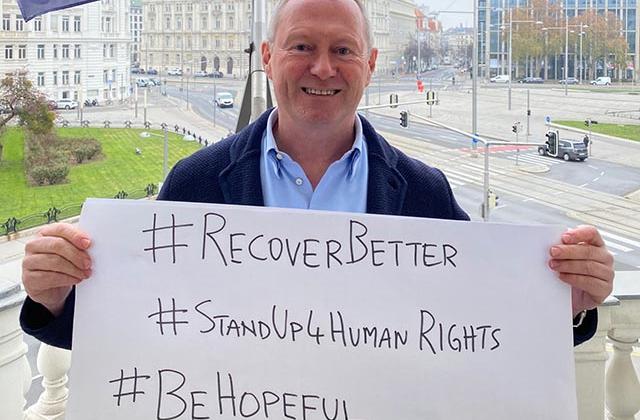
This year, the COVID-19 pandemic leaves a lasting mark on society worldwide. It affected everyone but some people more than others. As we look ahead, on Human Rights Day, on 10 December, we need to make the new normal a better normal. In his video message, FRA Director Michael O’Flaherty underlines the need to stand up for human rights to make 2021 a better year. This means ensuring we respect and take into account everybody's human rights.
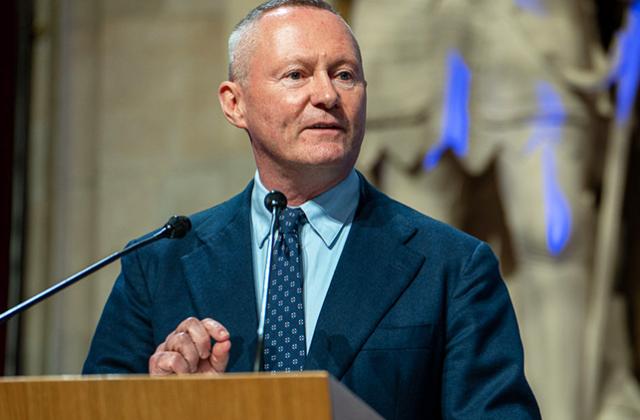
This video statement by FRA Director Michael O’Flaherty was recorded for the online event "Union of Equality: achievements and challenges ahead".
Vidéo
FRA asked 518 Travellers in Ireland about their life and experiences of discrimination.
Du suivi de la propagation de la COVID-19 à la détermination des bénéficiaires des prestations sociales, l’intelligence artificielle (IA) a une incidence sur la vie de millions d’Européens. L’automatisation peut améliorer la prise de décision. Mais l’IA peut conduire à des erreurs, entraîner une discrimination et être difficile à contester. Un nouveau rapport de l’Agence des droits fondamentaux de l’UE (FRA) révèle une certaine confusion quant à l’incidence de l’IA sur les droits des personnes, et ce même parmi les organisations qui l’utilisent déjà. La FRA invite les décideurs politiques à fournir davantage d’indications sur la manière dont les règles existantes s’appliquent à l’IA et à garantir que toute future loi en matière d’IA protège les droits fondamentaux.
This video statement by FRA Director Michael O’Flaherty was recorded for the 2020 General conference of the International Coalition of Inclusive and Sustainable Cities (ICCAR): “CommunicAction – A common front to protect human rights at the local level”.