Ο παρών οδηγός εξηγεί τι είναι η κατάρτιση προφίλ, τα νομικά πλαίσια που τη διέπουν και τον λόγο για τον οποίο η νόμιμη κατάρτιση προφίλ δεν είναι μόνο απαραίτητη για τη συμμόρφωση με τα θεμελιώδη δικαιώματα, αλλά και καίριας σημασίας για την αποτελεσματική αστυνόμευση και διαχείριση των συνόρων. Ο οδηγός παρέχει επίσης πρακτικές οδηγίες σχετικά με τρόπους αποφυγής της παράνομης κατάρτισης προφίλ στο πλαίσιο αστυνομικών επιχειρήσεων και επι-χειρήσεων διαχείρισης των συνόρων.
This guide explains what profiling is, the legal frameworks that regulate it, and why conducting profiling lawfully is both necessary to comply with fundamental rights and crucial for effective policing and border management. The guide also provides practical guidance on how to avoid unlawful profiling in police and border management operations.
Tässä oppaassa selitetään, mitä profilointi on ja millä oikeudellisilla kehyksillä profilointia säännellään. Siinä myös osoitetaan, miksi profiloinnin tekeminen lainmukaisesti on sekä välttämätöntä perusoikeuksien noudattamiseksi että ratkaisevan tärkeää tehokkaan poliisitoiminnan ja rajaturvallisuuden varmistamiseksi. Oppaassa annetaan käytännön ohjeita siitä, miten laitonta profilointia voidaan välttää poliisi- ja rajaturvallisuustoimissa.
Az útmutató ismerteti, mi a profilalkotás, milyen jogi keretek szabályozzák, és miért tekinthető úgy, hogy a profilalkotás jogszerű elvégzése az alapvető jogoknak való megfeleléshez is szükséges, és az eredményes rendészeti fellépés és határigazgatás szempontjából is kulcsfontosságú. Az útmutató emellett gyakorlati iránymutatást kínál azzal kapcsolatban, hogy miként kerülhető el a jogellenes profilalkotás a rendőrségi és a határigazgatási műveletek során.
In deze gids wordt uitgelegd wat profilering is, welke wettelijke kaders van toepassing zijn en waarom een rechtmatige toepassing van profilering niet alleen nodig is om aan de grondrechten te voldoen, maar ook van cruciaal belang is voor een doeltreffende ordehandhaving en grensbeheer.
V tejto príručke sa vysvetľuje, čo je profilovanie, akými právnymi rámcami sa riadi, a prečo vykonávanie profilovania v súlade so zákonom je nutné na dodržiavanie základných práv, ako aj na účely efektívnej policajnej práce a riadenia hraníc. V príručke sa uvádzajú tiež praktické usmernenia týkajúce sa toho, ako zabrániť nezákonnému profilovaniu v policajných operáciách a operáciách riadenia hraníc.
The Convention on the Rights of Persons with Disabilities commits both the EU and all of its Member States to realising the right of persons with disabilities to live independently in the community – which includes achieving deinstitutionalisation for those residing in institutional settings. But much remains to be done to make this a reality in practice. This report presents the main insights gained during fieldwork on the drivers of and barriers to deinstitutionalisation. Focusing on the local level, it gives voice to a diverse set of actors – most importantly, to people with disabilities themselves.
Almost twenty years after adoption of EU laws forbidding discrimination, people of African descent in the EU face widespread and entrenched prejudice and exclusion. This report outlines selected results from FRA's second large-scale EU-wide survey on migrants and minorities (EU-MIDIS II) carried out in 2016. It examines the experiences of almost 6,000 people of African descent in 12 EU Member States.
Civil society organisations play a critical role in democracies, and the importance of their work is widely recognised in international legal and policy documents. However, they face many obstacles when it comes to their day-to-day work. Based on the results of an online consultation with FRA's civil society network, the Fundamental Rights Platform (FRP), in September 2018, this paper complements the January 2018 report.
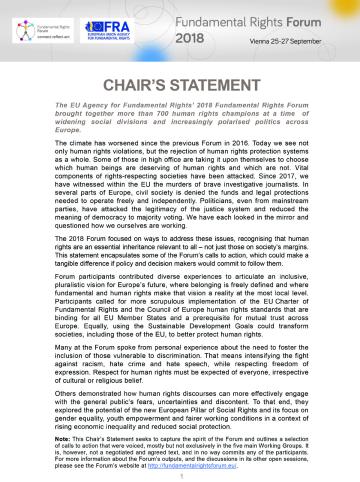
The EU Agency for Fundamental Rights’ 2018 Fundamental Rights Forum
brought together more than 700 human rights champions at a time of
widening social divisions and increasingly polarised politics across
Europe.
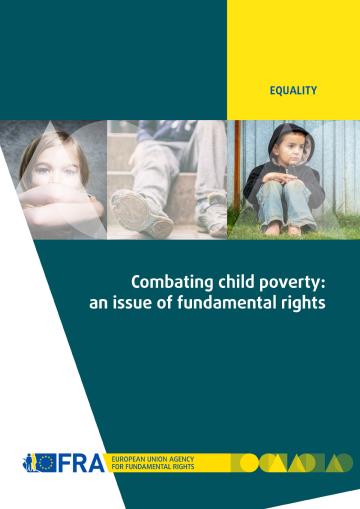
Almost 25 million children under 18 are at risk of poverty or social exclusion in the EU. Poverty deprives children of educational
opportunities, childcare, access to health care, adequate food and housing, family support and even protection from violence.
This report outlines data and survey findings that highlight the magnitude of child poverty in the EU, but also presents tools
available to counter this phenomenon and keep track of progress made.
With this Opinion, FRA aims to contribute to the European Parliament's own-initiative report on the “Implementation of the Charter of Fundamental Rights of the European Union in the EU institutional framework”, being prepared in the Parliament’s Committee for Constitutional Affairs (AFCO). The request aims at understanding the interaction between the Charter’s implementation at national and EU level, and whether there are “instruments, mechanisms and practices” available at EU level to assist Member States to better implement the Charter.
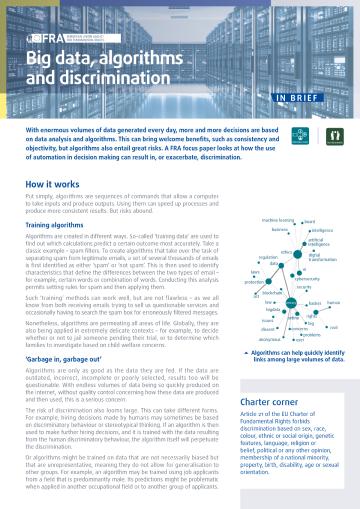
With enormous volumes of data generated every day, more and more decisions are based on data analysis and algorithms. This can bring welcome benefits, such as consistency and objectivity, but algorithms also entail great risks. A FRA focus paper looks at how the use of automation in decision making can result in, or exacerbate, discrimination.
This Opinion by the European Union Agency for Fundamental Rights (FRA) aims to inform the European Parliament’s position concerning the legislative proposal for a Regulation on strengthening the security of identity cards of European Union (EU) citizens and of residence documents issued to EU citizens and their family members exercising their right of free movement. It focuses on the processing of biometric data and complements the opinion published by the European Data Protection Supervisor (EDPS).
In November 2017, the European Commission requested FRA’s support in evaluating the impact on fundamental rights of the European Border Surveillance System (Eurosur) Regulation. Further to this request, FRA reviewed the work of the European Border and Coast Guard Agency (Frontex) and analysed cooperation agreements concluded by EU Member States with third countries which are relevant for the exchange of information for the purposes of Eurosur. This report presents the main findings of such review.
This Opinion aims to
inform the European Parliament’s position on the legislative proposal amending the
Visa Information System, the Visa Code and other related provisions of EU law. The
European Commission presented the proposal on 16 May 2018 and EU legislators are
currently discussing it.
The founding treaties, the EU Charter of Fundamental Rights and secondary EU law all provide for EU citizens’ freedom to move and reside freely in any EU country of their choice. Growing numbers of citizens, and their family members, are making use of this freedom and related rights, such as the right not to be discriminated against based on nationality and the right to vote in certain elections in the host Member State. But making these rights a reality remains a challenge. This report presents an EU-wide, comparative overview of the application of the Free Movement Directive (2004/38/EC) across the 28 Member States based on a review of select case law at national level.
Across the European Union, people face hatred because of their skin colour, ethnicity, religion, gender or sexuality. In response, the EU and its Member States have introduced laws against hate crime and support services for victims. But these will only fulfil their potential if victims report hate-motivated harassment and violence to the police, and if police officers record such incidents as hate crimes. This report provides rich and detailed information on hate crime recording and data collection systems across the EU, including any systemic cooperation with civil society.
European societies are not getting any younger! It is a simple truth we must face both about ourselves and Europe as a whole. In two generations, by 2080, those aged 65 or above will account for almost 30% of the European Union’s population.
The year 2017 brought both progress and setbacks in terms of rights protection. The European Pillar of Social Rights marked an important move towards a more ‘social Europe’. But, as experiences with the EU Charter of Fundamental Rights underscore, agreement on a text is merely a first step. Even in its eighth year as the EU's binding bill of rights, the Charter's potential was not fully exploited, highlighting the need to more actively promote its use.