Displaying 1 - 20 of 301
  • 27
    novembre
    2025
    This report looks at the breadth and depth of violence and neglect faced by people with disabilities living in institutions. It highlights the shortcomings by EU Member States in preventing violence and protecting those who are at a higher risk of experiencing it, in line with the UN Convention on the Rights of Persons with Disabilities. Based on research across all EU Member States and FRA observer candidate countries, the report calls for better protection, stronger prevention of violence, and clear accountability. It urges the EU and its Member States to implement their obligations around equality and fundamental rights.
  • 2
    octobre
    2025
    This report examines the fundamental rights and living conditions of Roma and Travellers across 10 EU Member States and
    3 accession countries. The survey evaluates progress towards the EU Roma strategic framework’s 2030 objectives, covering areas such as discrimination, poverty, education, employment, health, and housing.
  • FRA’s 2024 survey on Roma and Travellers in Albania, Bulgaria, Czechia, France, Greece, Hungary, Ireland, Italy, North Macedonia, Portugal, Romania, Serbia and Spain collected information from 10,126 respondents living in private households who self-identify as Roma or Traveller, are 16 or older and have lived in the survey countries for at least the 12 months before the survey.
  • 17
    septembre
    2025
    This report highlights the discrimination, harassment, violence, and non-consensual medical interventions faced by intersex people across 30 European countries, based on responses from nearly 2,000 participants in FRA's 2023 EU LGBTIQ Survey III. It reveals that many intersex individuals also identify as trans, non-binary, gender-diverse and have varied sexual orientations, which further compounds their experiences of discrimination. The report aims to support the development of laws and policies that promote the inclusion and dignity of intersex people.
  • 10
    juin
    2025
    The Fundamental Rights Report 2025 is the annual report of the European Union Agency for Fundamental Rights (FRA). It provides an overview of the state of fundamental rights in the EU and highlights selected critical developments and trends in 2024. The report covers issues such as inclusive elections, gender-based violence, and the implementation of the EU Charter of Fundamental Rights. It presents FRA’s opinions on these developments, setting out the actions that the EU and Member States should take. This annual publication is a valuable resource for those seeking to stay informed about the EU’s shifting landscape of fundamental rights.
  • 29
    avril
    2025
    National Human Rights Institutions (NHRIs) play an important role in providing independent human rights protection in EU Member States. Since 2020, the European Union Agency for Fundamental Rights (FRA) has been tracking the accreditation status and mandates of NHRIs across the EU. The 2025 annual update continues this work. These updates examine whether NHRIs are involved in monitoring compliance with fundamental rights in the use of EU funds, and how they use the EU Charter of Fundamental Rights when advising governments or carrying out education, training, and awareness-raising activities.
  • 20
    mars
    2025
    In recent years, the EU has taken steps to improve child protection, yet some Member States do not have an integrated approach. FRA first produced an overview of child protection systems in the EU in 2014, and an update in 2023. The data is published in FRA’s ‘Mapping of Child Protection Systems in the EU – Update 2023’. This report completements the 2023 update with comparative analysis and provides greater detail on children in vulnerable situations, care and the participation of children in matters affecting them. It also offers guidance on creating comprehensive frameworks that ensure that children’s rights are respected.
  • 30
    janvier
    2025
    This technical report presents in detail the stages of the survey implementation and the relevant information needed to assess the quality and reliability of the data.
  • 28
    novembre
    2024
    This paper outlines key challenges and solutions when it comes to promoting and protecting victims’ rights across the EU. It draws on FRA research over the past decade. It focuses on reporting crime, protection from secondary victimisation, victim support services. The paper highlights challenges and solutions in each of these areas, drawing directly from FRA’s published work. The challenges are based on the Agency’s data gathered from large-scale quantitative surveys of victims and in-depth qualitative research, including testimonies from victims and practitioners. The solutions draw from effective practices in various EU countries that address the practical needs of victims and improve their access to rights.
  • 30
    juillet
    2024
    Fundamental rights violations on the EU’s land and sea borders often go unreported. Investigations into these violations need to be more effective. This report gathers examples of alleged rights violations of migrants and refugees between 2020 and 2023. It sets out 10 steps to promote prompt and effective national investigations into incidents of ill-treatment at borders.
  • 11
    juillet
    2024
    Antisemitism is still a reality for many Jewish people in the EU today. Faced with prejudice and hostility, most feel unable to live openly Jewish lives. This report presents the results of FRA’s third EU survey of Jewish people’s experiences and perceptions of antisemitism. The survey took place before the Hamas attacks in October 2023 and the war in Gaza; however, it includes evidence from a consultation with national and European Jewish umbrella organisations since. It covers 13 EU Member States that together account for around 96 % of the EU’s Jewish population.
  • The third iteration of the EU LGBTIQ Survey of the European Union Agency for Fundamental Rights (FRA), was conducted in 2023. It presents the experiences of LGBTIQ people across the EU 27 Member States, and the candidate countries Albania, North Macedonia and Serbia, on the extent to which they enjoy fundamental rights. It provides policymakers with a solid empirical basis for evidence-based policies to ensure respect and protection for and fulfilment of the fundamental rights of LGBTIQ people. This interactive data explorer shows data from the survey for over 150 questions and contains multiple options for filtering, exporting and sharing the data.
  • 5
    juin
    2024
    FRA’s Fundamental Rights Report 2024 analyses the year’s developments in fundamental rights. It focuses on the most pressing fundamental rights concerns facing Europe in 2023: the cost-of-living crisis, rights concerns at the EU’s external borders and migration, and threats to democracy. Re-structured, this year’s new approach is a shorter and sharper analysis. It also presents FRA’s opinions on these developments, including a summary of the evidence supporting these opinions.
  • 14
    mai
    2024
    FRA’s third LGBTIQ survey shows that people still experience hate-motivated violence and discrimination. Trans and intersex people face even greater victimisation. Yet, signs of progress show that the EU’s and Member States’ efforts can positively affect people’s lives. More LGBTIQ people are open about their sexual orientation, gender identity, gender expression and sex characteristics.
  • 17
    avril
    2024
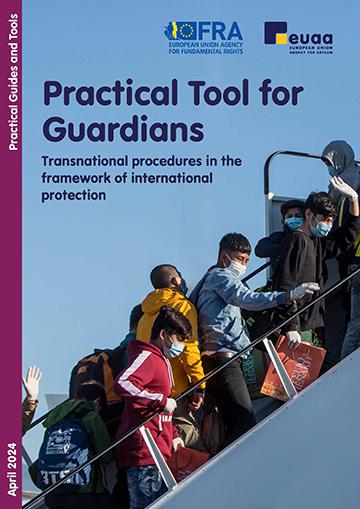
    This booklet is intended to support guardians assigned to children in the asylum procedure. It covers the technical aspects of the legal procedures related to the cross-border movement of such children. This booklet covers only procedures related to international protection. It is part of a series of four practical tools for guardians of unaccompanied children with international protection needs. The objective is to support guardians in their daily tasks and responsibilities during the asylum procedure, including the procedure under the Dublin III regulation and temporary protection. The tools have been developed by the European Union Agency for Asylum (EUAA) and FRA.
  • 10
    avril
    2024
    Racism in the police can include discriminatory racial profiling practices through to excessive use of force. Incidents like these highlight deeper systemic issues that need addressing. Many in society are affected by racism in policing, not only the individuals or communities targeted. Lack of trust in policing can fuel social exclusion and damages the foundations of a fair and equal society, however promising practices are developing to address these issues. This is the first EU-wide report on racism in policing. FRA’s findings identify gaps in regulatory frameworks and propose concrete steps for action.
  • 6
    Février
    2024
    The 2024 update on NHRIs accreditation status and mandates also covers their engagement in the monitoring of fundamental rights compliance in the use of EU funds at national level. Moreover, the update also shows how NHRIs make use of the EU Charter of Fundamental Rights in their work when advising government or in education, training and awareness raising activities. Since its 2020 report 'Strong and effective national human rights institutions – challenges, promising practices and opportunities', the European Union Agency for Fundamental Rights (FRA) has been regularly tracking the accreditation status and mandates of NHRIs.
  • 31
    janvier
    2024
    Children’s rights exist to ensure the safety and wellbeing of every child. Improved child protection systems ensure that these rights are met. In recent years, the EU has taken significant steps to improve child protection systems. This mapping of child protection systems gives an overview of the state of such systems at national level and developments since 2015. It promotes the improvement of integrated child protection systems. It is an update of FRA’s mapping of child protection systems in 2015, based on data collected in 2023 in the 27 EU Member States. By publishing this, FRA aims to support securing the sustainable well-being, safety and rights of all children living in the EU.