Children are full-fledged holders of rights. They are beneficiaries of all human and fundamental rights and subjects of special regulations, given their specific characteristics. This handbook aims to illustrate how European law and case law accommodate the specific interests and needs of children. It also considers the importance of parents and guardians or other legal representatives and makes reference, where appropriate, to situations in which rights and responsibilities are most prominently vested in children’s carers. It is a point of reference on both European Union (EU) and Council of Europe (CoE) law related to these subjects, explaining how each issue is regulated under EU law, including the Charter of Fundamental Rights of the European Union, as well as under the European Convention on Human Rights, the European Social Charter and other CoE instruments.
Les enfants sont des titulaires de droits à part entière. Ils sont bénéficiaires de tous les droits fondamentaux et de tous les droits de l’homme, et sont sujets de réglementations particulières compte tenu de leurs caractéristiques spécifiques. Le présent manuel a pour but de montrer comment le droit et la jurisprudence européens s’adaptent aux intérêts et besoins particuliers des enfants. Il illustre également l’importance des parents et des tuteurs ou d’autres représentants légaux et fait référence, le cas échéant, aux principaux droits et responsabilités conférés aux personnes ayant la charge des enfants. Ce manuel entend sensibiliser le lecteur et approfondir ses connaissances des normes juridiques qui protègent et promeuvent les droits de l’enfant en Europe. Il constitue un ouvrage de référence sur le droit de l’Union européenne et du Conseil de l’Europe dans ces domaines. Il explique comment chaque question est réglementée en vertu du droit de l’UE, y compris de la charte des droits fondamentaux de l’Union européenne, ainsi qu’en vertu de la convention européenne des droits de l’homme, de la charte sociale européenne et d’autres instruments du Conseil de l’Europe.
The EU is facing a large-scale humanitarian crisis. Over 10 days at the beginning of March, the EU Agency for Fundamental Rights (FRA) visited all EU countries bordering Ukraine and Moldova – Hungary, Poland, Romania and Slovakia.
The Fundamental Rights Forum 2021 was the space for dialogue on the human rights challenges facing the EU today. In this video, participants talk about the challenges of fundamental rights in the digital age.
The EU Agency for Fundamental Rights has been regularly collecting data on asylum and migration since September 2015. This report focuses on the fundamental rights situation of people arriving in Member States and EU candidate countries particularly affected by migration. It addresses fundamental rights concerns between 1 July and 30 September 2021.
FRA Opinion 1/21 illustrates the extent and nature of lived experiences of inequality and discrimination across the EU. It does so with reference to the grounds of discrimination and areas of life covered by the racial and employment equality directives, as well as by the proposed Equal Treatment Directive. It was issued on 30 April 2021. This summary presents the main recommendations (‘Key findings and opinions’) outlined in FRA Opinion 1/21.
L’avis 1/2021 de la FRA illustre l’étendue et la nature des expériences vécues en matière d’inégalité et de discrimination à travers l’UE. Ce faisant, il se réfère aux motifs de discrimination et aux domaines de la vie couverts par la directive sur l’égalité en matière d’emploi et par la directive sur l’égalité raciale, ainsi que par la proposition de directive sur l’égalité de traitement. Cet avis a été publié le 30 avril 2021. Le présent résumé rassemble les principales recommandations («Points clés et avis») décrites dans l’avis 1/2021 de la FRA.
This report examines the EU’s main criminal law instrument in the field of counter-terrorism, Directive (EU) 2017/541. Specifically, it considers how the directive engages issues of fundamental rights, affecting individuals, groups and society as a whole.
Antisemitic incidents and hate crimes violate fundamental rights, especially the right to human dignity, the right to equality of treatment, and the freedom of thought, conscience and religion. This report provides an overview of available data on antisemitism as recorded by official and unofficial sources in the EU Member States as well as Albania, North Macedonia and Serbia. The data provided by the countries are supplemented with information from international organisations.
The EU Agency for Fundamental Rights has been regularly collecting data on asylum and migration since September 2015. This report focuses on the fundamental rights situation of people arriving in Member States and EU candidate countries particularly affected by migration. It addresses fundamental rights concerns between 1 January and 30 June 2021.
This report examines why victims do not report bias-motivated incidents and the barriers that they face when reporting incidents through national crime reporting systems. By mapping existing practices that have a bearing on the victim’s experiences when reporting bias-motivated violence and harassment, it aims to provide evidence to support national efforts to encourage and facilitate reporting – and ultimately assist Member States in delivering on their duties with regard to combating hate crime.
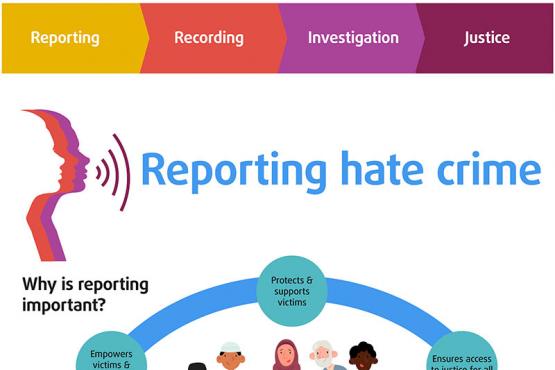
Drawing on the ‘Encouraging hate crime reporting: the role of law enforcement and other authorities' report, in this infographic FRA outlines why reporting is so important and what must change to encourage hate crime reporting.
The Consolidated annual activity report 2020 provides an overview of the activities and achievements of the European Union Agency for Fundamental Rights (FRA) in that year. It follows the guidelines established by the European Commission.
Le Rapport d’activité annuel consolidé 2020 fournit une vue d’ensemble des
activités et des réalisations de l’Agence européenne des droits fondamentaux
(FRA) au cours de cette année. Il respecte les lignes directrices établies par
la Commission Européenne.
The Employers Sanctions Directive was primarily enacted to dissuade employers from recruiting migrants in an irregular situation, but it also contains provisions to protect workers. It facilitates access to justice for exploited workers and sets out workers’ rights to claim back payment of outstanding wages. The directive also contains provisions to enhance the effectiveness of labour inspections. This report describes how the 25 Member States bound by the directive have been implementing its protective provisions, focusing on the impact these provisions have on migrant workers in an irregular situation who are victims of exploitation and other labour
law violations.
FRA’s Fundamental Rights Report 2021 reviews major developments in the field in 2020, identifying both achievements and areas of concern. It also presents FRA’s opinions on these developments, including a synopsis of the evidence supporting these opinions. This year’s focus chapter explores the impact of the COVID-19 pandemic on fundamental rights. The remaining chapters cover: the EU Charter of Fundamental Rights; equality and non-discrimination; racism, xenophobia and related intolerance; Roma equality and inclusion; asylum, borders and migration; information society, privacy and data protection; rights of the child; access to justice; and the implementation of the Convention on the Rights of Persons with Disabilities.
This focus looks at COVID-19’s impact on fundamental rights. It underscores that a human rights-based approach to tackling the pandemic requires balanced measures that are based on law, necessary, temporary and proportional. It also requires addressing the pandemic’s socio-economic impact, protecting the vulnerable and fighting racism.
This paper presents statistical survey data for the EU on how often people are stopped by the police, in what kind of situations they are stopped, the action taken by the police during stops, and views on whether or not the police acted respectfully.
This opinion illustrates the extent and nature of lived experiences of inequality and discrimination across the EU. It does so with reference to the grounds of discrimination and areas of life covered by the racial and employment equality directives, as well as in relation to the grounds and areas covered by the proposed Equal Treatment Directive.
This report looks at the practical implementation of the presumption of innocence in criminal proceedings, and related rights, in 9 EU Member States (Austria, Belgium, Bulgaria, Cyprus, Germany, Italy, Lithuania, Poland and Portugal). Article 48 of the EU Charter of Fundamental Rights guarantees the presumption of innocence – but, as FRA’s research underscores, it can be undermined in many ways.