This Opinion by the European Union Agency for Fundamental Rights (FRA) aims to inform
the European Parliament’s position on the legislative proposal on the European Border and
Coast Guard (EBCG) presented by the European Commission on 12 September 2018.
I denne vejledning forklares, hvad der forstås ved profilering, de retlige rammer, der regulerer profilering, og hvorfor det er både nødvendigt at foretage profilering lovligt for at overholde de grundlæggende rettigheder og afgørende for et effektivt politiarbejde og en effektiv grænseforvaltning. Vejledningen indeholder også praktiske retningslinjer om, hvordan ulovlig profilering kan undgås i forbindelse med politi- og grænseforvaltningsoperationer.
This guide explains what profiling is, the legal frameworks that regulate it, and why conducting profiling lawfully is both necessary to comply with fundamental rights and crucial for effective policing and border management. The guide also provides practical guidance on how to avoid unlawful profiling in police and border management operations.
Le présent guide explique le profilage, les cadres juridiques qui le régissent et les raisons pour
lesquelles le profilage licite est à la fois nécessaire pour garantir le respect des droits fondamentaux
et essentiel à l’efficacité des opérations de police et de gestion des frontières.
Šiame vadove paaiškinama, kas yra profiliavimas, kokios teisinės sistemos jį reglamentuoja ir kodėl teisėtai vykdyti profiliavimą yra būtina siekiant užtikrinti pagrindines teises ir ypač veiksmingą viešąją tvarką bei sienų valdymą. Vadove pateikiama ir praktinių patarimų, kaip išvengti neteisėto profiliavimo vykdant policijos ir sienų valdymo operacijas.
O presente guia explica o que é a definição de perfis, os quadros jurídicos que a regulam e a razão pela qual a definição lícita de perfis é necessária para fazer respeitar os direitos fundamentais e indispensável para a eficácia da ação policial e da gestão das fronteiras. O guia fornece igualmente orientações práticas sobre como evitar a definição ilícita de perfis nas operações policiais e de gestão das fronteiras.
I denna vägledning förklaras vad profilering innebär, vilken rättslig ram som utgör dess grund och varför en laglig profilering både är nödvändig för att uppfylla de grundläggande rättigheterna och helt avgörande för att effektivisera polisarbetet och gränsförvaltningen. Vägledningen innehåller även praktiska riktlinjer om hur olaglig profilering kan undvikas vid insatser inom polisverksamheten och gränsförvaltningen.
The Convention on the Rights of Persons with Disabilities commits both the EU and all of its Member States to realising the right of persons with disabilities to live independently in the community – which includes achieving deinstitutionalisation for those residing in institutional settings. But much remains to be done to make this a reality in practice. This report presents the main insights gained during fieldwork on the drivers of and barriers to deinstitutionalisation. Focusing on the local level, it gives voice to a diverse set of actors – most importantly, to people with disabilities themselves.
Almost twenty years after adoption of EU laws forbidding discrimination, people of African descent in the EU face widespread and entrenched prejudice and exclusion. This report outlines selected results from FRA's second large-scale EU-wide survey on migrants and minorities (EU-MIDIS II) carried out in 2016. It examines the experiences of almost 6,000 people of African descent in 12 EU Member States.
This report presents the main insights gained during the EU Fundamental Rights Agency’s project on local engagement for Roma inclusion, which explores how to best involve Roma in integration efforts at the local level. Bringing together local authorities and residents, especially Roma, it investigated what aspects work, which ones do not, and why this is the case.
As a very modern human rights catalogue containing many rights not found in established bills of rights, the Charter indeed looks good on paper. Those familiar with the main principles of EU law can usually quickly recite that the Charter is always binding on the EU, and binding on Member States only when they are "implementing EU law". But what does this often-quoted language from Article 51 of the Charter actually mean?
Almost 25 million children under 18 are at risk of poverty or social exclusion in the EU. Poverty deprives children of educational
opportunities, childcare, access to health care, adequate food and housing, family support and even protection from violence.
This report outlines data and survey findings that highlight the magnitude of child poverty in the EU, but also presents tools
available to counter this phenomenon and keep track of progress made.
With this Opinion, FRA aims to contribute to the European Parliament's own-initiative report on the “Implementation of the Charter of Fundamental Rights of the European Union in the EU institutional framework”, being prepared in the Parliament’s Committee for Constitutional Affairs (AFCO). The request aims at understanding the interaction between the Charter’s implementation at national and EU level, and whether there are “instruments, mechanisms and practices” available at EU level to assist Member States to better implement the Charter.
These 10 keys sum up the core points
communicators and practitioners in various fields
raised in FRA’s expert meetings, practitioners’
seminars and focus groups in 2017 and 2018.
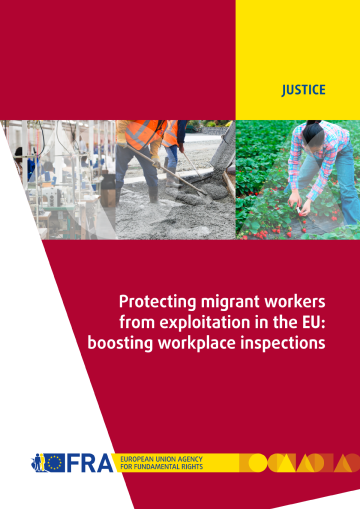
Severe labour exploitation is widespread across the European Union. While workplace inspections can help counter this phenomenon, they need to be strengthened to do so effectively. Based on interviews and focus group discussions with almost 240 exploited workers active in diverse economic sectors, this report provides important evidence on how unscrupulous employers manipulate and undermine inspections, and on what can be done to counteract such efforts.
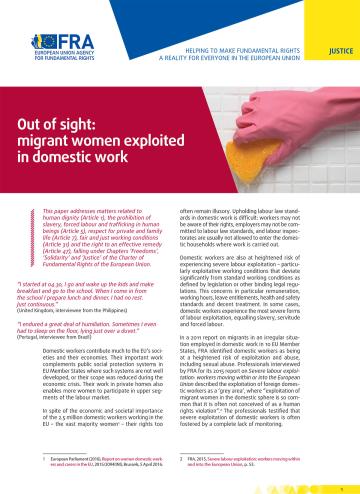
The stories of the domestic workers FRA interviewed for this paper reveal appalling working conditions and fundamental rights abuses in private homes across the EU. These stories indicate that, seven years on from FRA’s first report on domestic workers in 2011, little has changed in terms of the risks and experiences of severe labour exploitation domestic workers in the EU face.
We live in a world of big data, where technological developments in the area of machine learning and artificial intelligence have changed the way we live. Decisions and processes concerning everyday life are increasingly automated, based on data. This affects fundamental rights in various ways. This focus paper specifically deals with discrimination, a fundamental rights area particularly affected by technological developments.
Den hurtige udvikling inden for informations- og kommunikationsteknologi fremhæver det øgede behov for
solid beskyttelse af personoplysninger – en ret, der er sikret ved både EU’s og Europarådets instrumenter.
Beskyttelse af denne vigtige rettighed indebærer nye og væsentlige udfordringer, da teknologiske fremskridt
udvider mulighederne for f.eks. overvågning, opfangelse af kommunikation og lagring af data. Denne håndbog
har til formål at give jurister, som ikke er specialister inden for databeskyttelse, kendskab til dette nye
juridiske område.
The rapid development of information technology has exacerbated the need for robust personal data protection, the right to which is safeguarded by both European Union (EU) and Council of Europe (CoE) instruments. Safeguarding this important right entails new and significant challenges as technological advances expand the frontiers of areas such as surveillance, communication interception and data storage. This handbook is designed to familiarise legal practitioners not specialised in data protection with this emerging area of the law.
Dėl sparčios informacinių technologijų plėtros padidėjo poreikis užtikrinti patikimą asmens duomenų apsaugą
taikant tiek Europos Sąjungos, tiek Europos Tarybos priemones. Siekiant užtikrinti šią svarbią teisę, kyla naujų
ir svarbių uždavinių, nes dėl technologinės pažangos plečiamos tokių sričių, kaip stebėjimas, ryšių perėmimas
ir duomenų saugojimas, ribos. Šis vadovas parengtas siekiant supažindinti teisės specialistus, kurie neturi
itin daug žinių apie duomenų apsaugą, su šia naujai besiformuojančia teisės sritimi.