Data

Protection des données, respect de la vie privée et nouvelles technologies

    Produits

    Publications and Data

    Displaying results 41 - 50 of 107
    Fundamental Rights Report
    11
    juin
    2020
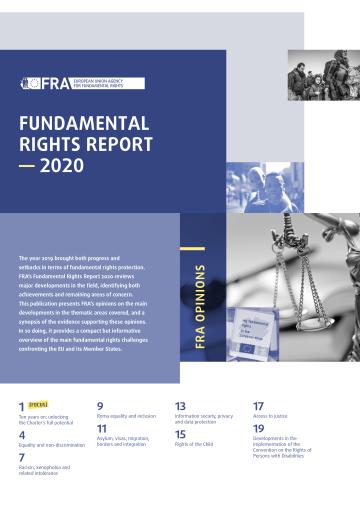
    L’année 2019 a été marquée à la fois par des avancées et des régressions en matière de protection des droits fondamentaux. Le Rapport sur les droits fondamentaux 2020 de la FRA examine les principales évolutions dans ce domaine, en recensant les progrès accomplis et les sujets de préoccupation persistants. La présente publication expose les avis de la FRA sur les principales évolutions dans les domaines thématiques couverts ainsi qu’un résumé des éléments factuels qui étayent ces avis. Elle fournit ainsi une vue d’ensemble concise mais instructive des principaux défis en matière de droits fondamentaux auxquels l’Union européenne (UE) et ses États membres doivent faire face.
    Fundamental Rights Report
    11
    juin
    2020
    FRA’s Fundamental Rights Report 2020 reviews major developments in the field in 2019, identifying both achievements and areas of concern. It also presents FRA’s opinions on these developments, including a synopsis of the evidence supporting these opinions. This year’s focus chapter explores how to unlock the full potential of the EU Charter of Fundamental Rights.
    Periodic updates / Series
    28
    mai
    2020
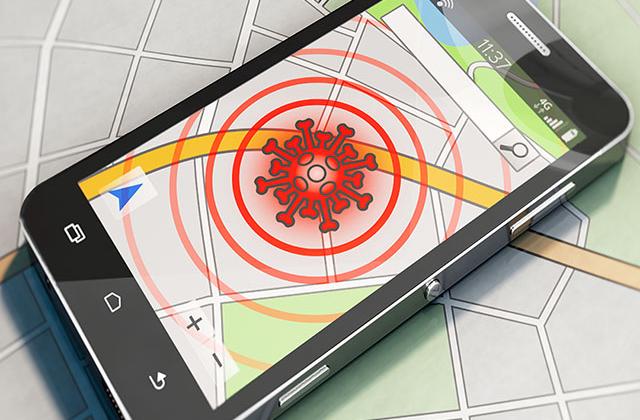
    The Coronavirus pandemic continues to interrupt everyday life in the EU in unprecedented ways. But the way it affects our societies is shifting. As governments gradually lift some of the measures put in place to contain the spread of COVID-19, new fundamental rights concerns arise: how to ensure that the rights to life and health are upheld as daily life transitions to a ‘new normal’. This Bulletin looks at declarations of states of emergency, or equivalent, and how they came under scrutiny. It considers the impact on fundamental rights in important areas of daily life, and includes a thematic focus on the processing of users’ data to help contain COVID-19, particularly by contact-tracing apps. It covers the period 21 March – 30 April 2020.
    Periodic updates / Series
    8
    avril
    2020
    The outbreak of COVID-19 affects people’s daily life in the 27 EU Member States. As the number of infected people in the EU territory began to mount rapidly in February and March, governments put in place a raft of measures – often introduced in a period of only a few days – in an effort to contain the spread of the virus. Many of these measures reflect how, in exceptional emergency situations, the urgent need to save lives justifies restrictions on other rights, such as the freedom of movement and of assembly. This report outlines some of the measures EU Member States have put in place to protect public health during the COVID-19 pandemic. It covers the period 1 February – 20 March 2020.
    Rapport / Publication / Résumé
    27
    novembre
    2019
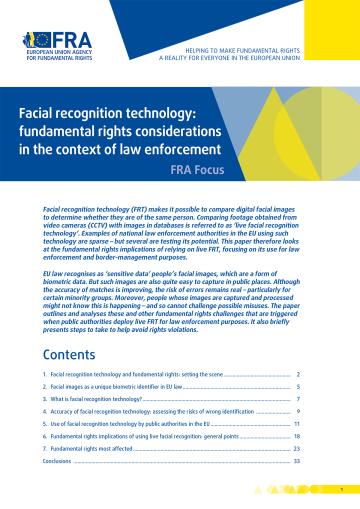
    La technologie de reconnaissance faciale permet de comparer des images faciales numériques afin de déterminer s’il s’agit d’une seule et même personne. La comparaison d’images obtenues à partir
    de caméras vidéo avec des images stockées dans des bases de données est appelée «technologie de reconnaissance faciale en temps réel». Les exemples d’autorités répressives nationales de l’Union européenne (UE) utilisant cette technologie sont rares, mais plusieurs d’entre elles testent actuellement son potentiel. Le présent document examine donc les implications en matière de droits fondamentaux de l’utilisation de la technologie de reconnaissance faciale en temps réel, en mettant l’accent sur son utilisation à des fins répressives et de gestion des frontières.
    Page
    Report / Paper / Summary
    12
    juin
    2019
    The General Data Protection Regulation (GDPR) has applied across the European Union (EU) since 25 May 2018. One year on, this paper looks at how the new regulation has affected the daily work of civil society organisations (CSOs).
    Report / Paper / Summary
    11
    juin
    2019
    Algorithms used in machine learning systems and artificial intelligence (AI) can only be as good as the data used for their development. High quality data are essential for high quality algorithms. Yet, the call for high quality data in discussions around AI often remains without any further specifications and guidance as to what this actually means.
    Fundamental Rights Report
    6
    juin
    2019
    How much progress can we expect in a decade? Various rights-related instruments had been in place for 10 years in 2018, prompting both sobering and encouraging reflection on this question.