Newsroom

The FRA Director visited the Canary Islands and met with the authorities in Spain to discuss the migratory situation in the Canary Islands.
FRA Director Michael O’Flaherty will be one of the inaugural speakers at an event to discuss challenges and the future for civil society organisations during and after COVID-19.
FRA will hold a meeting to prepare for the second part of its Procedural safeguards for children who are suspects or accused in criminal proceedings project.
The Italian Academy of Law and Migration held a launch event for the Italian version of the handbook on European law relating to asylum, borders and immigration.
FRA has just released key findings from its consultation with its Fundamental Rights Platform on the impact of COVID-19 measures on the work of human rights civil society.
En Europe, les femmes continuent d’être la cible courante d’actes de harcèlement et de violence. Nombreuses sont les femmes qui restreignent leurs déplacements et leurs rencontres, par crainte d’être agressées. Et très souvent, les femmes qui ont subi une agression ne la signalent pas. Telles sont quelques-unes des conclusions de l’enquête que vient de réaliser l’Agence des droits fondamentaux de l’UE (FRA) sur les expériences des victimes de certains types d’actes criminels. À l’occasion de la Journée internationale de la femme, la FRA appelle à une amélioration du soutien aux femmes, de façon à ce qu’elles puissent accéder à leurs droits.

FRA Director Michael O'Flaherty visited the Canary Islands in March 2021 to get a sense of the migration situation there. He highlights the need to support the Canary Islands in relocating unaccompanied children and providing clear procedures on asylum applications.
On 11 March, FRA will give a virtual lecture about the EU justice system and its legal bodies to the EU Delegation to Turkmenistan. FRA will give an overview on the EU policy system, the Agency’s work and how it protects human rights in the EU.
FRA will present findings from its work on the impact of COVID-19 on fundamental rights during the UNECE Regional Forum on Sustainable Development. It will be part of discussions on 10 March on how human rights can guide sustainable recovery. FRA will also draw on its work on implementing the Sustainable Development Goals in the EU. The event focuses on how to ensure that the principle of leaving no-one behind is entrenched in COVID-19 recovery strategies and plans.
FRA will give a presentation during a meeting on victims’ participation in criminal proceedings and access to justice. FRA will draw on its recently-published results from the Fundamental Rights Survey, as well as other FRA research.
The FRA Director will meet Werner Amon, one of the three Heads of the Austrian NHRI (Volksanwaltschaft) on 9 March.
The FRA Director will exchange views with EU Ministers of Justice during their informal videoconference on 11 March.
Article d'actualité
FRA’s Management Board issued its opinion on the agency’s thematic work areas for 2023-2027.
Two days of stimulating discussions, over 145 different sessions, 6 locations – that was the Fundamental Rights Forum 2021 in a nutshell. With over 3,000 people joining the Forum in Vienna and online, it was the biggest human rights event in Europe this year.
FRA seeks feedback from users on a range of its products, such as reports, datasets and handbooks.
FRA gave a presentation during Equinet’s roundtable discussion on the role of Equality Bodies in implementing the EU’s Strategic Framework for Roma Equality, Inclusion and Participation.
FRA will present its research findings during a side meeting at the UN Crime Congress. It will draw on results from its violence against women survey and fundamental rights survey.
Dans son tout dernier bulletin sur la migration, l’Agence des droits fondamentaux de l’Union européenne (FRA) recense un certain nombre de préoccupations persistantes et émergentes en matière de droits fondamentaux.
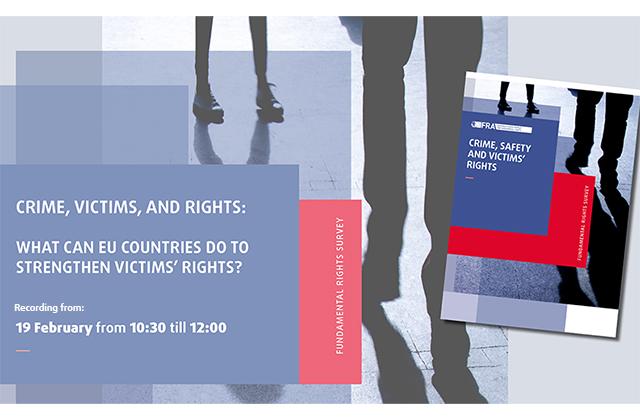
Crime can touch any of us – as witnesses or as victims. But no matter who you are, we all have rights when it comes to justice. It is for this reason that the European Union Agency for Fundamental Rights asked 35,000 people across Europe about their experiences of crime in its Fundamental Rights Survey, and the results are in.