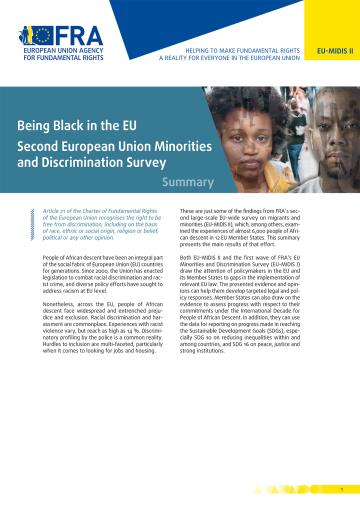
Across the EU, people of African descent face widespread and entrenched prejudice and exclusion. Racial discrimination and harassment are commonplace. Experiences with racist violence vary, but reach as high as 14 %. Discriminatory profiling by the police is a common reality. Hurdles to inclusion are multi-faceted, particularly when it comes to looking for jobs and housing.
Individuals who are not entitled to stay in the European Union are typically subject to being returned to their home countries. This includes children who are not accompanied by their parents or by another primary caregiver. But returning such children, or finding another durable solution, is a delicate matter, and doing so in full compliance with fundamental rights protections can be difficult. This focus paper therefore aims to help national authorities involved in return-related tasks, including child-protection services, to ensure full rights compliance.
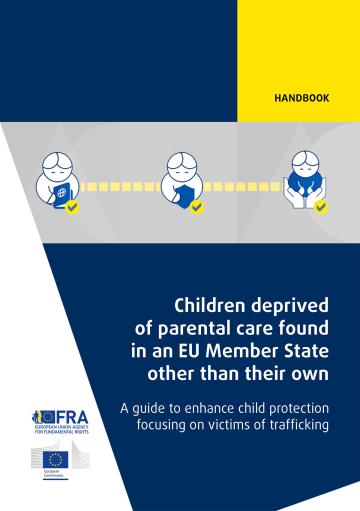
Children deprived of parental care found in another EU Member State other than their own aims to strengthen the response of all relevant actors for child protection. The protection of those girls and boys is paramount and an obligation for EU Member States, derived from the international and European legal framework. The guide includes a focus on child victims of trafficking and children at risk, implementing an action set forth in the 2017 Communication stepping up EU action against trafficking in human beings, and takes into account identified patterns, including with respect to the gender specificity of the crime.
Algorithms used in machine learning systems and artificial intelligence (AI) can only be as good as the data used for their development. High quality data are essential for high quality algorithms. Yet, the call for high quality data in discussions around AI often remains without any further specifications and guidance as to what this actually means.
The year 2018 brought both progress and setbacks in terms of fundamental rights protection. FRA’s Fundamental Rights Report 2019 reviews major developments in the field, identifying both achievements and remaining areas of concern. This publication presents FRA’s opinions on the main developments in the thematic areas covered, and a synopsis of the evidence supporting these
opinions.
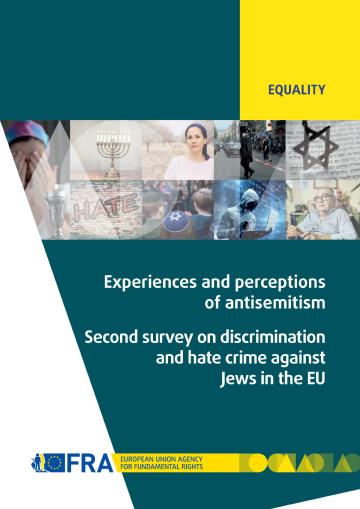
This summary outlines the main findings of FRA’s second survey on Jewish people’s experiences with hate crime, discrimination and antisemitism in the European Union – the biggest survey of Jewish people ever conducted worldwide.
This summary report presents the key findings of the fieldwork to identify and understand the operation of barriers to and drivers of successful investment in Roma inclusion and the FRA opinions stemming from them.
This report outlines the main findings of FRA’s second survey on Jewish people’s experiences with hate crime, discrimination and antisemitism in the European Union – the biggest survey of Jewish people ever conducted worldwide. Covering 12 EU Member States, the survey reached almost 16,500 individuals who identify as being Jewish. It follows up on the agency’s first survey, conducted in seven countries in 2012.
This guide explains what profiling is, the legal frameworks that regulate it, and why conducting profiling lawfully is both necessary to comply with fundamental rights and crucial for effective policing and border management. The guide also provides practical guidance on how to avoid unlawful profiling in police and border management operations.
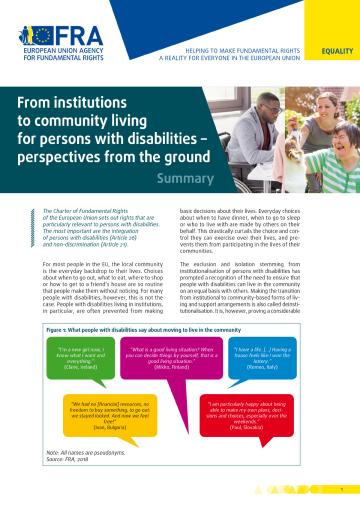
The Convention on the Rights of Persons with Disabilities commits both the EU and all of its Member States to realising the right of persons with disabilities to live independently in the community – which includes achieving deinstitutionalisation for those residing in institutional settings. But much remains to be done to make this a reality in practice. This report presents the main insights gained during fieldwork on the drivers of and barriers to deinstitutionalisation. Focusing on the local level, it gives voice to a diverse set of actors – most importantly, to people with disabilities themselves.
The European Union Agency for Fundamental Rights
(FRA) wanted to contribute to making steps to implement
deinstitutionalisation more effective, by capturing
concrete evidence of what is and what is
not working on the ground. To do this, the agency
conducted extensive fieldwork research in five EU
Member States at different stages of the deinstitutionalisation
process.
This summary report presents the key findings of
that fieldwork and the FRA opinions stemming from
them.
Almost twenty years after adoption of EU laws forbidding discrimination, people of African descent in the EU face widespread and entrenched prejudice and exclusion. This report outlines selected results from FRA's second large-scale EU-wide survey on migrants and minorities (EU-MIDIS II) carried out in 2016. It examines the experiences of almost 6,000 people of African descent in 12 EU Member States.
Civil society organisations play a critical role in democracies, and the importance of their work is widely recognised in international legal and policy documents. However, they face many obstacles when it comes to their day-to-day work. Based on the results of an online consultation with FRA's civil society network, the Fundamental Rights Platform (FRP), in September 2018, this paper complements the January 2018 report.
This report presents the main insights gained during the EU Fundamental Rights Agency’s project on local engagement for Roma inclusion, which explores how to best involve Roma in integration efforts at the local level. Bringing together local authorities and residents, especially Roma, it investigated what aspects work, which ones do not, and why this is the case.
As a very modern human rights catalogue containing many rights not found in established bills of rights, the Charter indeed looks good on paper. Those familiar with the main principles of EU law can usually quickly recite that the Charter is always binding on the EU, and binding on Member States only when they are "implementing EU law". But what does this often-quoted language from Article 51 of the Charter actually mean?
Almost 25 million children under 18 are at risk of poverty or social exclusion in the EU. Poverty deprives children of educational
opportunities, childcare, access to health care, adequate food and housing, family support and even protection from violence.
This report outlines data and survey findings that highlight the magnitude of child poverty in the EU, but also presents tools
available to counter this phenomenon and keep track of progress made.
These 10 keys sum up the core points
communicators and practitioners in various fields
raised in FRA’s expert meetings, practitioners’
seminars and focus groups in 2017 and 2018.
Across the European Union, Member States are faced with the challenge of integrating Europe’s most deprived
and disenfranchised minority groups. As a follow up to the EU-MIDIS II findings on Roma, this report presents
FRA’s findings relating to the issues of education and employment. Encouraging Roma participation in education
and employment equips communities with higher incomes, better life opportunities and greater social inclusion.
The year 2017 brought both progress and setbacks in terms of fundamental rights protection. FRA’s Fundamental Rights Report 2018 reviews major developments in the field, identifying both achievements and remaining areas of concern.
We live in a world of big data, where technological developments in the area of machine learning and artificial intelligence have changed the way we live. Decisions and processes concerning everyday life are increasingly automated, based on data. This affects fundamental rights in various ways. This focus paper specifically deals with discrimination, a fundamental rights area particularly affected by technological developments.