Over 2.5 million people applied for international protection in the 28 EU Member States in 2015 and 2016. Many of those who were granted some form of protection are young people, who are likely to stay and settle in the EU. The EU Agency for Fundamental Rights interviewed some of them, as well as professionals working with them in 15 locations across six EU Member States: Austria, France, Germany, Greece, Italy and Sweden. This report presents the result of FRA’s fieldwork research, focusing on young people between the
ages of 16 and 24.
Based on its findings and research FRA provides practical guidance to support the implementation of fundamental rights in the EU Member States. This series contains practical guidance on: Initial-reception facilities at external borders; Apprehension of migrants in an irregular situation; Guidance on how to reduce the risk of refoulement in external border management when working in or together with third countries; Fundamental rights implications of the obligation to provide fingerprints for Eurodac; Twelve operational fundamental rights considerations for law enforcement when processing Passenger Name Record (PNR) data and Border controls and fundamental rights at external land borders.
Child rights come first. Measures to ensure child protection and participation apply to all children in the EU. This brochure guides you to relevant FRA reports and tools that can support you when promoting and protecting the rights of all children in the EU.
This annual overview provides an update of the most recent figures on antisemitic incidents, covering the period 1 January 2008 – 31 December 2018, across the EU Member States, where data are available. It includes a section that presents evidence from international organisations. In addition, for the first time, it provides an overview of how Member States that have adopted or endorsed the non-legally binding working definition of antisemitism adopted by the International Holocaust Remembrance Alliance (IHRA) (2016) use or intend to use it.
The EU Agency for Fundamental Rights has been regularly collecting data on asylum and
migration since September 2015. This report focuses on the fundamental rights situation
of people arriving in Member States and EU candidate countries particularly affected by
migration. It addresses fundamental rights concerns between 1 July and 30 September 2019.
The EU Agency for Fundamental Rights has been regularly collecting data on migration since September 2015. This report focuses on the fundamental rights situation of people arriving in Member States and EU candidate countries particularly affected by migration movements. It addresses fundamental rights concerns between 1 April and 30 June 2019.
In the latest edition of his video blog, FRA Director Michael O'Flaherty focuses on the migration situation in the Mediterranean Sea and makes three proposals.
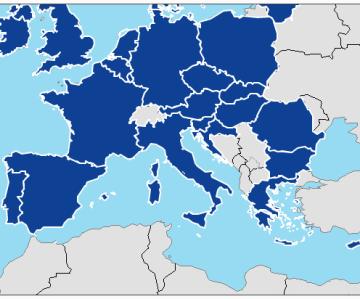
Based on FRA’s second large-scale survey on experiences and perceptions of antisemitism, this report focuses on the perspectives of young Jewish Europeans (aged 16-34) living in twelve EU Member States. It first describes this particular group and takes a look at defining antisemitism and understanding the place of Israel in it.
The EU Return Directive (2008/115/EC) in Article 8 (6) introduced an important fundamental rights safeguard for third-country nationals ordered to leave the EU because they do not or no longer fulfil the conditions for entry and/or stay. According to the directive, Member States must provide for an effective forced-return monitoring system.
In 2018, some 2,299 people are estimated to have died or gone missing at sea while crossing the sea to reach Europe to escape war or persecution or to pursue a better life. This is on average more than six people per day. Before mid-2017, a significant share of migrants in distress at sea have been rescued by civil society vessels deployed with a humanitarian mandate to reduce fatalities and bring rescued migrants to safety. In 2018, however, authorities in some Member States viewed civil society-deployed rescue vessels with hostility. As a reaction, they seized rescue vessels, arrested crew members, and initiated legal procedures against them (more than a dozen altogether). In some cases, rescue vessels were blocked in harbours due to flag issues.
This technical report presents in detail all the stages
of the survey and the relevant information needed to
assess the quality and reliability of the data, as well
as considerations for interpreting the survey results.
The following chapters of the report cover the procedures
used in the development and administration
of the survey.
The General Data Protection Regulation (GDPR) has applied across the European Union (EU) since 25 May 2018. One year on, this paper looks at how the new regulation has affected the daily work of civil society organisations (CSOs).
Algorithms used in machine learning systems and artificial intelligence (AI) can only be as good as the data used for their development. High quality data are essential for high quality algorithms. Yet, the call for high quality data in discussions around AI often remains without any further specifications and guidance as to what this actually means.
The EU Agency for Fundamental Rights has been regularly collecting data on migration since
September 2015. This report focuses on the fundamental rights situation of people arriving in
Member States and EU candidate countries particularly affected by migration movements.
It addresses fundamental rights concerns between 1 January and 31 March 2019.
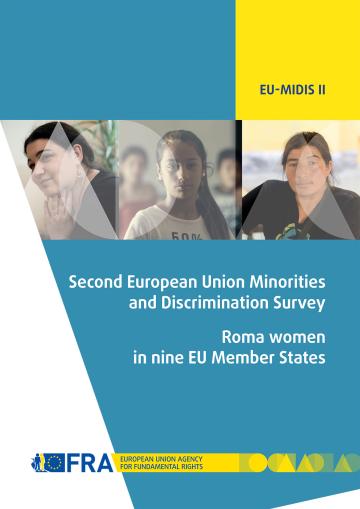
Despite efforts by the European Union (EU) and its Member States to reduce gender inequalities among citizens of Roma origin, important gender differences persist. Drawing on FRA’s own EU-MIDIS II survey research in nine EU Member States this report highlights the position of Roma women in education, employment and health, as well as the extent to which they experience hate-motivated discrimination, harassment and physical violence.
This report looks into the fundamental rights situation of asylum applicants and beneficiaries of international protection in the EU throughout 2018. It pulls together the main issues identified in FRA’s regular updates on fundamental rights related to asylum, migration and borders in selected EU Member States, which the agency has been publishing since September 2015.
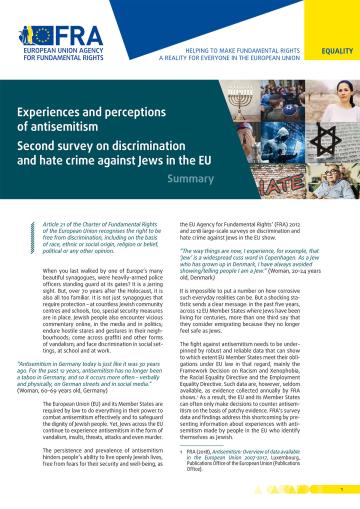
This summary outlines the main findings of FRA’s second survey on Jewish people’s experiences with hate crime, discrimination and antisemitism in the European Union – the biggest survey of Jewish people ever conducted worldwide.
This Opinion aims to inform the European Parliament’s position on the legislative proposal for a Regulation on preventing the dissemination of terrorist content online, presented by the European Commission on 12 September 2018.
The EU Agency for Fundamental Rights has been regularly collecting data on migration since
September 2015. This report focuses on the fundamental rights situation of people arriving in
Member States and EU candidate countries particularly affected by large migration movements.
This guide explains what profiling is, the legal frameworks that regulate it, and why conducting profiling lawfully is both necessary to comply with fundamental rights and crucial for effective policing and border management. The guide also provides practical guidance on how to avoid unlawful profiling in police and border management operations.