Artificial intelligence is everywhere and affects everyone – from deciding what content people see on their social media feeds to determining who will receive state benefits. AI technologies are typically based on algorithms that make predictions to support or even fully automate decision-making.
Antisemitic incidents and hate crimes violate fundamental rights, especially the right to human dignity, the right to equality of treatment and the freedom of thought, conscience and religion. This report provides an overview of available data on antisemitism as recorded by official and unofficial sources in the EU Member States and in Albania, North Macedonia and Serbia. The data provided by the countries are supplemented with information from international organisations.
** As of 19 September 2024 a new version of this guidance has been issued. Please see the link below. **
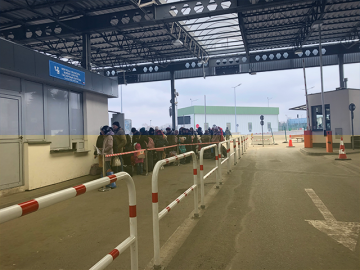
Fundamental rights monitoring at EU external borders should be systematically and regularly carried out for a range of border management activities. These include border surveillance, apprehensions at land, sea and air borders, and the operation of referral mechanisms, including in the event of mass arrivals. This general guidance provides assistance to EU Member States in setting up national independent mechanisms to monitor fundamental rights compliance at EU external borders, in line with the proposed screening regulation of 23 September 2020 by the European Commission. The EU Agency for Fundamental Rights prepared this guidance at the request of the Commission.
Acts of terrorism represent a serious threat to the lives and safety of people, and a profound security challenge for states. At the same time, counter-terrorism legislation, policies and other measures can entail, directly or indirectly, serious limitations to fundamental rights, and can adversely affect individuals, groups and society as a whole. This summary presents FRA’s main findings from its report on Directive (EU) 2017/541 on combating terrorism, the main criminal law instrument at EU level in the field of counter-terrorism.
Since 2014, FRA has been publishing an annual update of the forced return monitoring systems EU Member States have set up under Article 8 (6) of the EU’s Return Directive (2008/115/EC). This overview describes different indicators for an effective forced return monitoring system. It includes the organisation responsible for monitoring forced return, the number of operations monitored in 2021, the phases of monitored return operations, the number of staff trained and working as monitors, and whether the monitoring body issued public reports about their monitoring.
The Charter of Fundamental Rights of the European Union (CFREU) is the EU’s bill of rights. It always binds the EU institutions and the Member States when they act within the scope of EU law. However, it is far from easy to assess whether a concrete case falls within the scope of EU law. This is why it is necessary to provide training and training material to legal professionals so that they can understand the field of application of the Charter as laid out in its Article 51. This trainer’s manual aims at providing guidance on both the organisation and the implementation of such trainings based on a series of case studies,
which will be extended in the future.
Civil society organisations face diverse challenges across the European Union. FRA’s report on Protecting civic space in the EU presents the agency’s findings on these challenges. It was issued in September of 2021. This summary presents the Key findings and FRA opinions outlined in the report.
Civil society is a key component of Europe’s fundamental rights architecture. From supporting people affected by the pandemic to helping those fleeing the war in Ukraine, civil society plays a crucial role in upholding people’s rights. In so doing, it contributes to a healthy rule of law culture. FRA’s civic space report provides an overview of the many ways in which civil society contributes to the checks and balances that underpin the rule of law.
In this vlog, FRA Director Michael O'Flaherty, points to the need to recommit to human rights, as evidenced by the wide-ranging impact of the Covid-19 pandemic. Here he refers to vaccine inequalities and the impact on marginalised communities, disadvantaged children and frontline workers. As he explains in this vlog, human rights can help fix and strengthen society so we are ready for the next pandemic.
Every child has a right to be protected even when they are accused or suspected of committing a crime. The basic principles of justice apply to adults and children alike. But children face specific obstacles during criminal proceedings, such as a lack of understandable information about their rights, limited legal support and poor treatment. The report looks at the practical implementation of Directive (EU) 2016/800 on procedural safeguards for children who are suspects or accused persons in criminal proceedings in nine Member States – Austria, Belgium, Bulgaria, Germany, Estonia, Italy, Malta, Poland and Portugal.
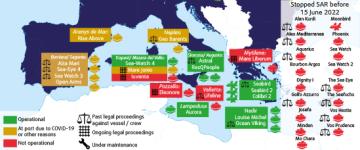
The EU Agency for Fundamental Rights (FRA) regularly collects data on the operations of NGO vessels involved in search and rescue in the Mediterranean. This includes any legal proceedings against them, as well as on any difficulties in disembarking migrants in safe ports. The International Organization for Migration estimates that from January to 15 June 2022 about 842 people died or went missing while crossing the Mediterranean Sea to reach Europe to escape war or persecution, or to pursue a better life. This is an average of five people per day.
FRA’s Fundamental Rights Report 2022 reviews major developments in the field in 2021, identifying both achievements and areas of concern. It also presents FRA’s opinions on these developments, including a synopsis of the evidence supporting these opinions.
This focus looks at the impact of the pandemic on social rights. It examines the measures in national recovery and resilience plans that address the social vulnerabilities among a variety of population groups in the EU, including women, children and young people in situations of vulnerability, people with disabilities, older people, Roma and people in precarious working conditions.
This bulletin looks at the fundamental rights situation of all persons fleeing the Russian war in Ukraine to the four EU Member States neighbouring Ukraine. This is primarily in terms of the application of the EU Temporary Protection Directive. It is based on findings of FRA’s field mission to Hungary, Poland, Romania and Slovakia at the beginning of March 2022. It is also based on weekly country reports prepared by Franet, the contracted research network of FRA between 1 March and 27 April 2022.
This guide can help cities wishing to improve their efforts to respect human rights. It aims to encourage local authorities to adopt higher human rights standards. The idea is to encourage and foster mutual learning on human and fundamental rights. The European Union Agency for Fundamental Rights (FRA), a group of human rights cities and various practitioners in the EU worked together to produce this guide. The guide draws on the promising practices and experiences of cities, regions, experts, international organisations and networks that can be found in the FRA report Human rights cities in the EU: A framework for reinforcing rights locally.
Children are full-fledged holders of rights. They are beneficiaries of all human and fundamental rights and subjects of special regulations, given their specific characteristics. This handbook aims to illustrate how European law and case law accommodate the specific interests and needs of children. It also considers the importance of parents and guardians or other legal representatives and makes reference, where appropriate, to situations in which rights and responsibilities are most prominently vested in children’s carers. It is a point of reference on both European Union (EU) and Council of Europe (CoE) law related to these subjects, explaining how each issue is regulated under EU law, including the Charter of Fundamental Rights of the European Union, as well as under the European Convention on Human Rights, the European Social Charter and other CoE instruments.
The EU is facing a large-scale humanitarian crisis. Over 10 days at the beginning of March, the EU Agency for Fundamental Rights (FRA) visited all EU countries bordering Ukraine and Moldova – Hungary, Poland, Romania and Slovakia.