Asylum

Frontières et systèmes d’information

Highlights

  • Handbook / Guide / Manual
    8
    octobre
    2025
    The Entry/Exit System (EES), launching in 2025, will register non-EU nationals crossing the EU’s external borders. This FRA guidance helps border guards apply the new rules in line with EU fundamental rights. It offers practical tips on informing people, collecting biometric data and supporting people with specific needs. Based on fieldwork at 10 border crossing points in 6 Member States, the guidance will ensure rights are respected under the new system. A separate guidance publication for managers accompanies this publication.
  • Periodic updates / Series
    20
    juin
    2025
    The EU Agency for Fundamental Rights regularly collects data on the operations of NGO vessels involved in search and rescue in the Mediterranean. This includes any legal proceedings against them, as well as any difficulties in disembarking migrants in safe ports. This paper provides an overview of criminal investigations and other legal proceedings initiated by European Union (EU) Member States against civil society organisations deploying search and rescue vessels and aircraft in the Mediterranean and/or against individual crew members. The latest update covers the period from 2018 up until 1 June 2025.
  • Handbook / Guide / Manual
    19
    septembre
    2024
    This publication guides EU countries on setting up independent monitoring mechanisms to ensure fundamental rights are respected during screening and asylum border procedures. These processes at borders are for people arriving from non-EU countries. Monitoring mechanisms are meant to prevent rights violations, protect victims, and support investigations into any allegations of wrongdoing by public authorities. The guidance highlights the importance of transparency and accountability, which builds trust in public authorities. New EU regulations coming into effect in 2026 will require such monitoring systems to be in place. This updates the guidance published in 2022.
  • Report / Paper / Summary
    30
    juillet
    2024
    Fundamental rights violations on the EU’s land and sea borders often go unreported. Investigations into these violations need to be more effective. This report gathers examples of alleged rights violations of migrants and refugees between 2020 and 2023. It sets out 10 steps to promote prompt and effective national investigations into incidents of ill-treatment at borders.

    Produits
    24
    juillet
    2020
    Les présentes orientations sont destinées aux agents chargés de la gestion des frontières au sein des États membres de l’Union européenne (UE) qui travaillent au niveau opérationnel. Elles visent à les aider à mettre en oeuvre, dans leurs activités quotidiennes, les garanties relatives aux droits fondamentaux du code frontières Schengen [règlement (UE) 2016/399] et le droit de l’Union correspondant.
    19
    juin
    2020
    In 2019, the International Organization for Migration estimated that 1,866 people have died or gone missing while crossing the Mediterranean Sea to reach Europe to escape war or persecution or to pursue a better life. This is an average of five people per day. In recent years, a significant proportion of migrants in distress at sea have been rescued by civil society vessels deployed with a humanitarian mandate to reduce fatalities and bring rescued migrants to safety. Since 2018, however, authorities in some EU Member States started viewing civil society-deployed rescue vessels with hostility. As a reaction, national authorities initiated about 40 administrative and criminal proceedings against crew members or vessels, including seizing the latter. In some cases, rescue vessels were blocked in harbours due to flag issues or the inability to meet technical requirements.
    27
    mars
    2020
    Les États membres du Conseil de l’Europe (CdE) et de l’Union européenne (UE) jouissent du droit indéniable de contrôler souverainement l’entrée des étrangers sur leur territoire. Dans l’exercice du contrôle de leurs frontières, les États ont le devoir de protéger les droits fondamentaux de toutes les personnes qui se trouvent sous leur juridiction, indépendamment de leur nationalité et/ou de leur situation juridique. Cela englobe la fourniture d’un accès aux procédures d’asile, conformément au droit de l’UE.
    16
    janvier
    2020
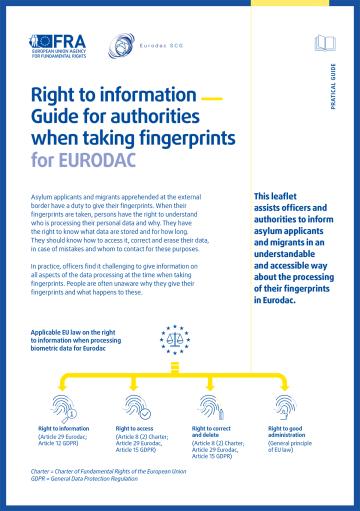
    Ce dépliant aide les agents et les autorités à informer de manière compréhensible et accessible les demandeurs d’asile et les migrants sur le traitement de leurs empreintes digitales dans Eurodac.
    In the latest edition of his video blog, FRA Director Michael O'Flaherty focuses on the migration situation in the Mediterranean Sea and makes three proposals.
    19
    juin
    2019
    In 2018, some 2,299 people are estimated to have died or gone missing at sea while crossing the sea to reach Europe to escape war or persecution or to pursue a better life. This is on average more than six people per day. Before mid-2017, a significant share of migrants in distress at sea have been rescued by civil society vessels deployed with a humanitarian mandate to reduce fatalities and bring rescued migrants to safety. In 2018, however, authorities in some Member States viewed civil society-deployed rescue vessels with hostility. As a reaction, they seized rescue vessels, arrested crew members, and initiated legal procedures against them (more than a dozen altogether). In some cases, rescue vessels were blocked in harbours due to flag issues.
    11
    mars
    2019
    In November 2016, FRA formulated 21 individual opinions to address the fundamental rights shortcomings identified in the implementation of the hotspot approach in Greece and Italy. Despite genuine efforts to improve the situation since November 2016, many of the suggestions contained in the 21 opinions FRA formulated at the time remain valid.
    1
    octobre
    2018
    This note draws attention to the recent trend of criminalising search and rescue operations (SAR) in the Mediterranean Sea carried out by non-governmental organisations (NGOs) or other private entities. This includes seizing rescue vessels, as well as arrests for crew members, in some EU Member States. Most of such incidents concerned NGOs operating in the Central Mediterranean Sea.
    14
    septembre
    2018
    This Opinion by the European Union Agency for Fundamental Rights (FRA) aims to inform the European Parliament’s position concerning the legislative proposal for a Regulation on strengthening the security of identity cards of European Union (EU) citizens and of residence documents issued to EU citizens and their family members exercising their right of free movement. It focuses on the processing of biometric data and complements the opinion published by the European Data Protection Supervisor (EDPS).
    10
    septembre
    2018
    This Opinion aims to
    inform the European Parliament’s position on the legislative proposal amending the
    Visa Information System, the Visa Code and other related provisions of EU law. The
    European Commission presented the proposal on 16 May 2018 and EU legislators are
    currently discussing it.
    19
    avril
    2018
    This Opinion by the European Union Agency for Fundamental Rights (FRA) aims to inform the European Parliament position concerning legislative proposals on interoperability between EU information technology systems (IT systems) presented on 12 December 2017 and currently discussed by the EU legislators.
    28
    mars
    2018
    This report outlines the fundamental rights implications of collecting, storing and using
    biometric and other data in EU IT systems in the area of asylum and migration.
    11
    juillet
    2017
    The European Parliament requested this FRA Opinion on the fundamental rights and personal data protection implications of the proposed Regulation for the creation of a European Travel Information and Authorisation System (ETIAS), including an assessment of the fundamental rights aspects of the access
    by law enforcement authorities and Europol.
    7
    juillet
    2017
    Various proposals on EU-level information systems in the areas of borders and security mention interoperability, aiming to provide fast and easy access to information about third-country nationals.
    25
    janvier
    2017
    The European Parliament asked the Agency to provide its Opinion on the fundamental rights impact of the proposed revision of the Eurodac Regulation on children.
    5
    décembre
    2016
    EU Member States are increasingly involved in border management activities on the high seas, within – or i cooperation with – third countries, and at the EU’s borders. Such activities entail risks of violating the principle of non-refoulement, the cornerstone of the international legal regime for the protection of refugees, which prohibits returning individuals to a risk of persecution. This report aims to encourage fundamental-rights compliant approaches to border management, including by highlighting potential grey areas.
    5
    décembre
    2016
    Les États membres de l’UE participent de plus en plus à des activités de gestion des frontières en haute mer, sur le territoire de pays tiers, ou en coopération avec ces derniers, ainsi qu’aux frontières de l’UE. Ces activités peuvent comporter des risques de violation du principe de non-refoulement, la pierre angulaire du régime international juridique assurant la protection des réfugiés, qui interdit le retour d’individus vers une situation de risque de persécution. Ces orientations présentent des suggestions spécifiques sur les moyens de réduire les risques de refoulement dans ces situations. Elles constituent un outil pratique élaboré à l’aide de contributions d’experts réunis à Vienne en mars 2016.
    30
    mai
    2016
    Ce « Focus » examine de façon approfondie les questions de l’asile et de la
    migration dans l’Union européenne (UE) en 2015. Il se penche sur l’efficacité des mesures prises ou proposées par l’UE et
    ses États membres pour gérer cette situation, en se concentrant en particulier sur le respect des droits fondamentaux.
    21
    décembre
    2015
    The proposal to establish a possible legislative instrument supplementing the existing European Criminal Records Information System with information on third-country nationals convicted in the EU raises a number of fundamental rights issues.
    22
    octobre
    2015
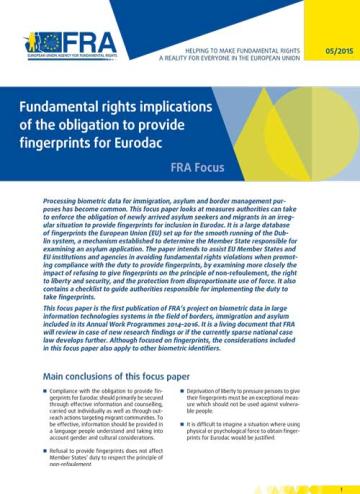
    Processing biometric data for immigration, asylum and border management purposes has become common. This focus paper looks at measures authorities can take to enforce the obligation of newly arrived asylum seekers and migrants in an irregular situation to provide fingerprints for inclusion in Eurodac.