Equality

Origine raciale et ethnique

Highlights

  • Report / Paper / Summary
    10
    avril
    2024
    Racism in the police can include discriminatory racial profiling practices through to excessive use of force. Incidents like these highlight deeper systemic issues that need addressing. Many in society are affected by racism in policing, not only the individuals or communities targeted. Lack of trust in policing can fuel social exclusion and damages the foundations of a fair and equal society, however promising practices are developing to address these issues. This is the first EU-wide report on racism in policing. FRA’s findings identify gaps in regulatory frameworks and propose concrete steps for action.
  • Report / Paper / Summary
    25
    octobre
    2023
    FRA's first Being Black in the EU report exposed widespread and entrenched racism against people of African descent in Europe. Now updated with new data, this report revisits the situation revealing persistent racial discrimination, harassment and violence. Overall, experiences of racial discrimination increased in the EU countries since 2016, reaching as high as 77%. The lack of progress is alarming despite binding anti-discrimination law in the EU since 2000 and significant EU policy developments since then.
  • Report / Paper / Summary
    25
    mai
    2021
    This paper presents statistical survey data for the EU on how often people are stopped by the police, in what kind of situations they are stopped, the action taken by the police during stops, and views on whether or not the police acted respectfully.
  • Explorateur de données
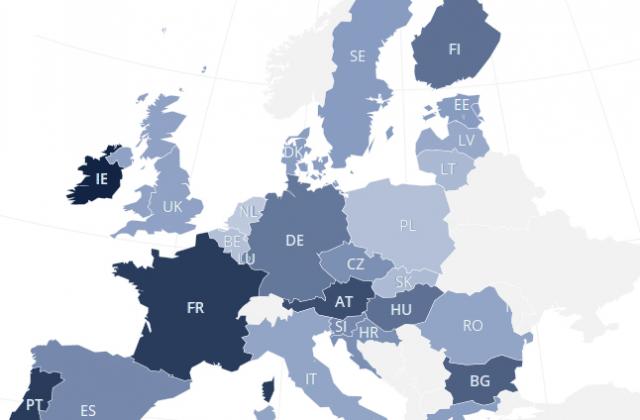
    This survey involved interviews with 25,515 people with different ethnic minority and immigrant backgrounds across 28 EU countries. It explores issues concerning discrimination as well as experiences of harassment, hate-motivated violence and discriminatory profiling.
    Produits
    8
    mars
    2019
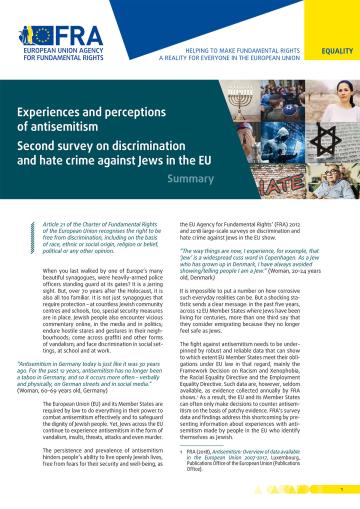
    Le présent document expose les principales conclusions
    de la deuxième enquête de la FRA sur les
    expériences des personnes juives en rapport avec
    le crime de haine, la discrimination et l’antisémitisme
    dans l’Union européenne.
    10
    décembre
    2018
    This report outlines the main findings of FRA’s second survey on Jewish people’s experiences with hate crime, discrimination and antisemitism in the European Union – the biggest survey of Jewish people ever conducted worldwide. Covering 12 EU Member States, the survey reached almost 16,500 individuals who identify as being Jewish. It follows up on the agency’s first survey, conducted in seven countries in 2012.
    5
    décembre
    2018
    Le présent guide explique le profilage, les cadres juridiques qui le régissent et les raisons pour
    lesquelles le profilage licite est à la fois nécessaire pour garantir le respect des droits fondamentaux
    et essentiel à l’efficacité des opérations de police et de gestion des frontières.
    Black people in the EU face unacceptable difficulties in getting a decent job because of their skin colour. Racist harassment also remains all too common.
    28
    novembre
    2018
    Almost twenty years after adoption of EU laws forbidding discrimination, people of African descent in the EU face widespread and entrenched prejudice and exclusion. This report outlines selected results from FRA's second large-scale EU-wide survey on migrants and minorities (EU-MIDIS II) carried out in 2016. It examines the experiences of almost 6,000 people of African descent in 12 EU Member States.
    20
    septembre
    2018
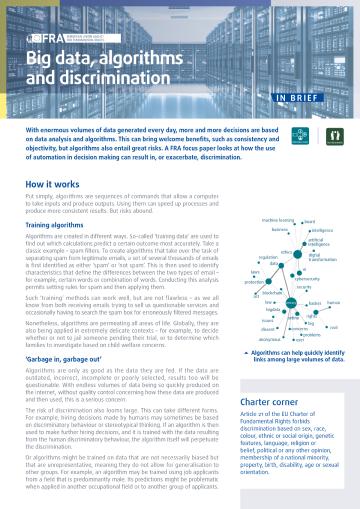
    With enormous volumes of data generated every day, more and more decisions are based on data analysis and algorithms. This can bring welcome benefits, such as consistency and objectivity, but algorithms also entail great risks. A FRA focus paper looks at how the use of automation in decision making can result in, or exacerbate, discrimination.
    29
    août
    2018
    The founding treaties, the EU Charter of Fundamental Rights and secondary EU law all provide for EU citizens’ freedom to move and reside freely in any EU country of their choice. Growing numbers of citizens, and their family members, are making use of this freedom and related rights, such as the right not to be discriminated against based on nationality and the right to vote in certain elections in the host Member State. But making these rights a reality remains a challenge. This report presents an EU-wide, comparative overview of the application of the Free Movement Directive (2004/38/EC) across the 28 Member States based on a review of select case law at national level.
    30
    mai
    2018
    We live in a world of big data, where technological developments in the area of machine learning and artificial intelligence have changed the way we live. Decisions and processes concerning everyday life are increasingly automated, based on data. This affects fundamental rights in various ways. This focus paper specifically deals with discrimination, a fundamental rights area particularly affected by technological developments.
    The EU's Agency for Fundamental Rights (FRA) and the OSCE Office for Democratic Institutions and Human Rights (ODIHR) work together to help states improve their ability to record and collect hate crime data through national workshops.
    21
    mars
    2018
    Le droit européen en matière de non-discrimination, constitué en particulier des directives européennes relatives à la non-discrimination, de l’article 14 de la Convention européenne des droits de l’homme et du Protocole nº 12 à cette convention, interdit toute discrimination fondée sur un certain nombre de motifs et exercée dans un certain nombre de contextes. Le présent manuel examine la législation européenne dans ce domaine, telle qu’elle découle de ces deux sources fondamentales, citant indifféremment l’un ou l’autre de ces systèmes juridiques complémentaires lorsque ceux-ci se recoupent ou mettant en exergue leurs divergences lorsqu’ils diffèrent.
    6
    décembre
    2017
    Seventeen years after adoption of EU laws that forbid discrimination, immigrants, descendants of immigrants, and minority ethnic groups continue to face widespread discrimination across the EU and in all areas of life – most often when seeking employment. For many, discrimination is a recurring experience. This is just one of the findings of FRA’s second European Union Minorities and Discrimination Survey (EU-MIDIS II), which collected information from over 25,500 respondents with different ethnic minority and immigrant backgrounds across all 28 EU Member States.
    The EU Agency for Fundamental Rights (FRA) launches its second EU Minorities and Discrimination Survey (EU-MIDIS II).
    This survey involved interviews with 25,515 people with different ethnic minority and immigrant backgrounds across 28 EU countries. It explores issues concerning discrimination as well as experiences of harassment, hate-motivated violence and discriminatory profiling.
    This infographic illustrates the main experiences immigrants and ethnic minorities across the EU have when it comes to discrimination. It draws from the findings from FRA's EU-MIDIS II survey.
    This infographic illustrates the main experiences immigrants and ethnic minorities across the EU have when it comes to victimisation. It draws from the findings from FRA's EU-MIDIS II survey.
    17
    novembre
    2016
    Media content and political discourse in EU Member States, whether online or
    offline, show incitement to discrimination, hatred or violence on different
    grounds, as evidence collected by FRA reveals. The growing reliance on the internet as the main source of
    information for many enables the fast spread of often unverified statements
    that could also incite to hatred.
    30
    septembre
    2015
    Regardless of ethnic origin, religion or belief, everyone living in the Union has a fundamental right to be treated equally, to be respected and to be protected from violence. This contribution paper to the Annual Colloquium
    on Fundamental Rights provides evidence of the fact that such respect is lacking, and suggests ways in which governments can ensure they fulfil their duty to safeguard this right for everyone living in the EU.
    12
    janvier
    2015
    The rights of victims of crime to access justice and to be protected against repeat victimisation may remain illusory in practice if the victim fails to receive professional advice and support. This research by the European Union Agency
    for Fundamental Rights (FRA) examines support service provision for such victims across the 28 EU Member States, in line with the 2012 EU Victims’ Directive. It focuses not on abstract fundamental rights standards but on the final
    practical results.
    20
    décembre
    2013
    This thematic situation report examines the effectiveness of responses by public authorities, civil society organisations and others to counter racism, discrimination, intolerance and extremism in Greece and Hungary. The report goes on to make proposals for fighting racist crime, increasing trust in the police, and combating extremism throughout the EU.
    This 2012 survey provides comparable data from eight countries (Belgium, France, Germany, Hungary, Italy, Latvia, Sweden and the UK) on Jewish people’s experiences and perceptions of discrimination, hate-motivated crime and antisemitism. The data explorer also allows the filtering of responses by age, gender and strength of Jewish identity of respondents.